
What to Do When You Don't Have Time to Market Your Business
Too busy running your business to keep up with marketing? Here’s how small business owners can prioritize, automate, outsource, and build a marketing system that keeps working.
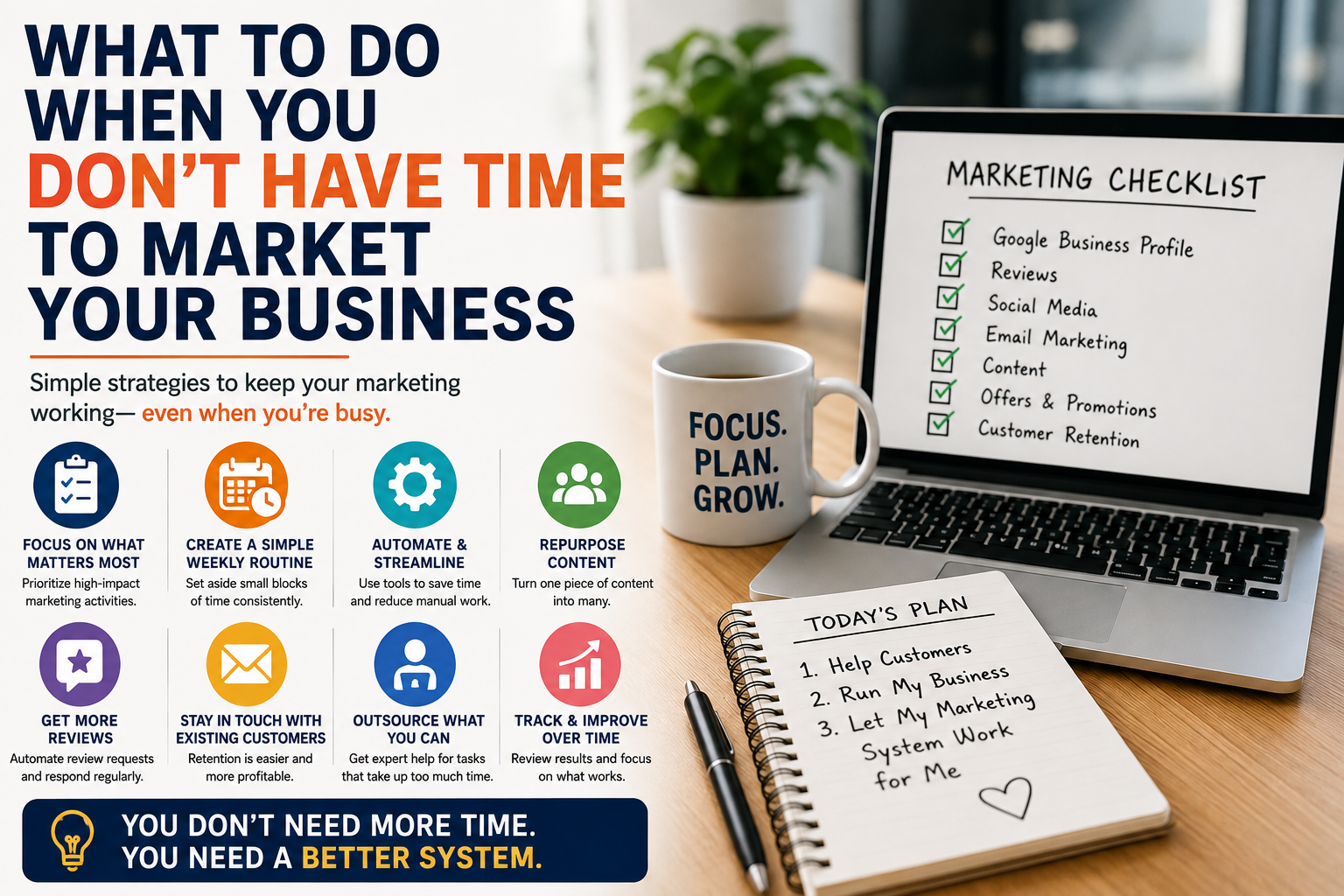
You know you should be marketing your business.
You should probably post on social media.
You need more Google reviews.
Your website could use an update.
You haven't posted anything to your Google Business Profile in weeks.
You meant to send customers that promotion.
And somewhere on your to-do list is:
“Figure out SEO.”
But then an employee calls out.
A customer needs help.
Inventory needs to be ordered.
A vendor calls.
Payroll is due.
And marketing gets pushed to tomorrow.
Again.
If that sounds familiar, you're not bad at marketing.
You're busy running a business.
The solution isn't necessarily finding another five hours every week.
It's creating a marketing system that doesn't depend on you remembering to do everything yourself.
First: Stop Trying to Do Every Type of Marketing
One reason marketing becomes overwhelming is that small business owners are constantly told they need to be everywhere.
Instagram.
Facebook.
TikTok.
Google.
Email.
YouTube.
SEO.
Paid ads.
Blogs.
Text marketing.
Influencers.
Networking.
You probably don't need all of them.
For most local businesses, a much simpler system can work.
Focus first on:
- Being easy to find on Google
- Having strong reviews
- Making your services easy to understand
- Making booking or contacting you simple
- Staying reasonably active online
- Bringing previous customers back
Get those working before adding more channels.
1. Prioritize Marketing That Can Keep Working After You Do It
Not every marketing task has the same lifespan.
An Instagram Story may disappear in 24 hours.
A useful service page on your website could bring customers from Google for years.
A good Google review can influence hundreds of future customers.
An optimized Google Business Profile can help people find you every day.
If your time is limited, prioritize work that continues creating value.
For example:
Higher-leverage tasks
- Improve your Google Business Profile
- Ask customers for reviews
- Create important service pages
- Improve online booking
- Publish useful SEO articles
- Set up automated follow-ups
- Create customer loyalty programs
These tasks can keep working even when you're busy doing something else.
2. Pick Your Three Most Important Marketing Activities
Don't start Monday with a list of 27 marketing tasks.
Choose three.
For many local businesses, I would start with:
Keep your Google Business Profile accurate and active.
Reviews
Keep generating recent customer reviews.
Customer retention
Stay in contact with people who have already purchased from you.
Once those systems are working reliably, add another.
Marketing becomes much easier when you stop treating every possible tactic as equally urgent.
3. Create a Simple Weekly Marketing Routine
Marketing often disappears because there is no specific time assigned to it.
Instead of saying:
“I'll do marketing when I have time.”
choose a small recurring block.
For example:
Monday — 15 minutes
Check your Google Business Profile.
Update hours, information, photos, or services if needed.
Wednesday — 20 minutes
Prepare one or two social posts.
Friday — 15 minutes
Check reviews and respond.
Once a month
Review your offers, website, local SEO, and marketing results.
That's less intimidating than thinking:
“I need to work on marketing.”
Specific tasks are easier to complete than vague goals.
4. Batch Your Marketing
Don't stop what you're doing every day to create another post.
Batch similar tasks together.
Instead of taking 20 minutes every morning to figure out what to post, spend an hour creating several pieces of content at once.
For example, take photos during one afternoon:
- Your team
- Your products
- Your workspace
- Your most popular service
- Behind-the-scenes moments
Then turn those photos into several weeks of posts.
You can do the same with:
- Blog topics
- Offers
- Emails
- Review replies
- Google posts
- Videos
Switching constantly between running the business and thinking creatively about marketing wastes time.
Batching reduces that mental switching.
5. Turn Work You're Already Doing Into Content
You don't always need to invent marketing content.
Document the business.
If you're a restaurant, photograph today's special.
If you're a salon, show today's finished hairstyle.
If you're a contractor, photograph a completed project.
If you're an auto shop, explain a common issue you fixed today.
If you're a dentist, answer a question patients repeatedly ask.
One real customer question can become:
A blog article
A social post
A short video
A Google Business Profile update
An FAQ on your website
Marketing gets much easier when you reuse information you're already producing.
6. Automate Repetitive Tasks
There are many marketing tasks that don't need to be handled manually every single time.
Depending on your business, you may be able to automate:
- Appointment reminders
- Review requests
- Rebooking messages
- Email campaigns
- Birthday offers
- Customer follow-ups
- Social scheduling
- Loyalty rewards
- Lead follow-ups
For example:
Instead of manually remembering to ask every customer for a review, send an automatic review request after their appointment.
Instead of personally reminding every customer to rebook, automate the reminder.
You should spend your time where human judgment matters.
Let systems handle repetitive work.
7. Use AI for the First Draft
A lot of marketing time is lost staring at a blank page.
“What should I post?”
“What should I write?”
“What should the email say?”
“What should this promotion be called?”
AI can help create the starting point.
Use it to draft:
- Social media posts
- Review responses
- Blog outlines
- Email campaigns
- Promotion ideas
- FAQ answers
- Website descriptions
Then review and personalize the result.
AI shouldn't replace your understanding of your customers.
It should reduce the amount of time required to turn that understanding into marketing material.
8. Stop Designing Everything From Scratch
You don't need a completely different design every time you post.
Create reusable templates for:
- Customer testimonials
- Promotions
- Tips
- New products
- Events
- Announcements
- Before-and-after photos
Then replace the photo and text.
Consistency can actually strengthen your branding while saving time.
Your customers don't expect every Facebook post to look like a Super Bowl commercial.
They care much more about whether the information is useful.
9. Make Review Requests Automatic
Reviews are one of the easiest marketing activities to neglect.
Don't rely on employees remembering to say:
“Would you mind leaving us a review?”
Create a system.
You can use:
QR code at checkout
Direct review link
Post-appointment text
Follow-up email
Receipt message
Ask consistently.
Over time, five reviews become fifty.
Fifty become one hundred.
That's how small marketing actions compound.
10. Let Your Customers Create Some of Your Marketing
Your happiest customers can help you produce content.
With permission, use:
- Testimonials
- Customer photos
- Before-and-after results
- Reviews
- Customer stories
- User-generated social posts
Instead of always telling people:
“We're great.”
let customers show why they chose you.
That's often much more persuasive anyway.
11. Focus More on Existing Customers
If you have almost no time for marketing, don't spend all of it trying to find strangers.
Your existing customers already know your business.
Market to them.
Send:
- Rebooking reminders
- Loyalty rewards
- New service announcements
- Seasonal offers
- Referral promotions
- Birthday offers
- “We haven't seen you recently” messages
Sometimes the fastest way to increase revenue isn't finding another 100 customers.
It's getting your current customers to visit one additional time.
12. Improve the Marketing You Already Have Before Adding More
Before starting TikTok because everyone says you should be on TikTok, check whether the basics are working.
Is your website clear?
Is your phone number correct?
Does your booking link work?
Are your hours accurate on Google?
Do you have recent reviews?
Can customers immediately understand what you offer?
Marketing doesn't always require creating something new.
Sometimes the best use of an hour is fixing something that's already costing you customers.
13. Delegate Tasks That Don't Need You
Being the owner doesn't mean every Instagram caption needs your personal approval.
Decide which marketing decisions actually require you.
Maybe you provide:
- Offers
- Business priorities
- Brand direction
- Important announcements
Someone else can handle:
- Posting
- Scheduling
- Formatting
- Review monitoring
- Website updates
- Reporting
Your job should increasingly become:
Approve the direction.
Not:
Personally execute every marketing task.
14. Outsource the Work That Requires Expertise
There are also areas where spending ten hours trying to learn something yourself may make less sense than hiring someone who already knows how to do it.
You might outsource:
- Local SEO
- Google Business Profile management
- Paid advertising
- Website development
- Social media
- Graphic design
- Content creation
The key is avoiding another problem:
Hiring five different freelancers and spending all your time managing them.
Outsourcing should reduce your workload, not create another job.
15. Build a System That Works When You're Busy
This is the real goal.
Your marketing shouldn't disappear every time business gets busy.
Because that's usually what happens.
Business is slow.
You start marketing.
Business improves.
You get busy.
You stop marketing.
A few months later, business slows down again.
Then you panic and start marketing again.
That's a terrible cycle.
Good marketing keeps working during busy months so you don't have to constantly restart from zero.
What Should You Do If You Only Have One Hour a Week?
If I had only one hour per week to market a local business, I would divide it roughly like this:
15 minutes — Google Business Profile
Check your information, add a photo, update anything that changed.
15 minutes — Reviews
Respond to new reviews and make sure review requests are going out.
15 minutes — Content
Create or approve a few posts.
15 minutes — Customers
Send a promotion, rebooking message, loyalty offer, or follow-up campaign.
Then I'd automate or outsource as much of the repetitive execution as possible.
You Don't Need More Time. You Need Less Marketing Work on Your Plate.
Small business owners are constantly told:
“You need to market your business more.”
But sometimes that's not useful advice.
You already know.
The problem is that you're responsible for:
employees
customers
inventory
operations
finances
vendors
sales
and everything else that happens between opening and closing.
The answer isn't squeezing more responsibilities into an already full day.
The better question is:
How much of your marketing actually needs to be done by you?
Usually, the answer is:
Less than you think.
Let the Marketing Keep Running While You Run the Business
Marketing still needs strategy.
Your business still needs your voice.
And you should still understand what's happening.
But you don't need to personally execute every marketing task.
Build systems.
Automate repetitive work.
Reuse content.
Delegate.
Outsource specialized work.
And focus your own time on the decisions only you can make.
That's how you keep marketing your business without turning yourself into a full-time marketer.
When You Don't Have Time for Marketing, That's Where YupUp Comes In
Orbit by YupUp is built for small business owners who know marketing matters but don't have the time to manage everything themselves.
Orbit helps keep important marketing work moving across areas like:
- Google Business Profile
- Local SEO
- Reviews
- Social media
- Content
- Offers
- Booking
- Customer loyalty
So instead of adding another marketing task to your to-do list, you can focus on the work your business actually needs you for.
You run the business. Orbit helps keep the marketing running.
Need a review and local marketing system?
YupUp helps independent businesses manage reviews, local visibility, and customer follow-up with AI-assisted workflows.
Get a free growth review