
So This Is Ownership: What Happens When You Run Out—or Throw Too Much Away?
An empty pan can look like success. A full bin can look like failure. Before changing the order, find out what the service actually tells you about demand, preparation, and safe use.
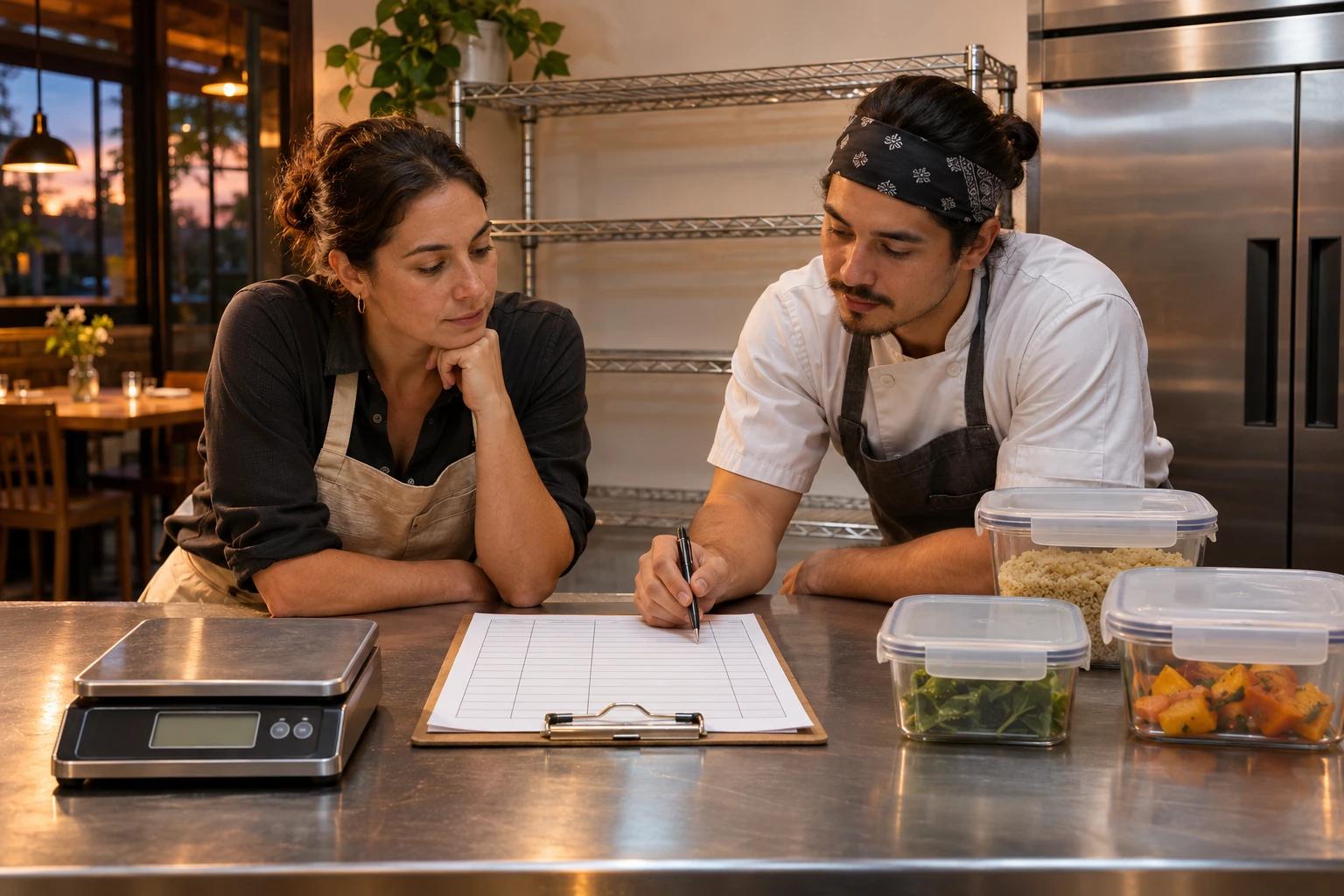
At 12:10, the last portion goes across the counter. You feel relieved: people wanted the food.
Then another customer asks for the same dish. There is more than an hour of service left. At closing, a different component still fills several containers.
This is a hypothetical service, not a real restaurant's results. It shows why selling out and having surplus can happen together. The question is not simply whether you bought too much or too little. You need to know what ran out, what remained, when it happened, and why.
Today's first article built an opening order from demand assumptions, portions, yields, stock, and pack sizes. This one closes the loop. What should change when customers and kitchen work do not match the plan?
When an item runs out, update the promise first
Have the shift lead confirm what is unavailable. Is the ingredient genuinely gone, or is the next batch not ready? Can the team safely prepare more within the approved operation and a realistic time?
Do not promise a restock time because a customer is waiting. Establish what can actually happen, then update the counter team, menu displays, and relevant ordering channels. Check orders already accepted and communicate directly with affected customers about the available options and any cancellation or refund handling under your policies and applicable obligations.
Offer a suitable alternative with the customer's agreement. Never make an unannounced ingredient substitution. A change can affect allergens, dietary needs, portion, price, or the reason someone chose the dish.
Give staff a clear escalation route for questions they cannot verify. This is where yesterday's order-handoff training earns its place in the operating plan.
Record the time, not only the final sales total
Imagine you prepared 40 portions and sold all 40. That does not prove demand was exactly 40.
If the dish disappeared early, later interest is partly hidden. Record the stockout time and observable requests you could not fulfill, while recognizing that you will not see every customer who chose something else or left.
In a separate invented example, an item sells out at 11:45 during service scheduled until 1:30. Staff record nine later requests. Forty sold portions plus nine recorded requests gives useful evidence of unmet interest, but not a complete demand forecast: the requests might include people who ultimately bought another dish, and other lost interest was never recorded.
Keep that distinction when estimating lost revenue. Do not automatically multiply every inquiry by the menu price and call the result cash the business would certainly have earned.
Find out whether the shortage began in purchasing or preparation
An ingredient can be on site while the dish is unavailable. Before increasing the supplier order, check the path from delivery to sale.
ObservationQuestion before buying moreRaw ingredients remain, but no ready portionsWas preparation quantity or timing the constraint?The item sold unusually quicklyDid an event, promotion, or menu-mix change alter demand?Portions were larger than the recipeWas the standard taught and followed?Received quantity was below the orderWas there a short shipment, rejection, or recording error?Food was removed from useWas there a safety, quality, equipment, or handling problem?Several dishes ran out togetherDid they share an ingredient whose combined demand was missed?
Use the answers to change the right thing. A second case does not fix a preparation station that cannot replenish safely during service.
Reconcile what happened to the food
Use consistent units and avoid mixing purchased weight with ready-to-serve portions. Record purchases and ingredient use separately from a prepared-batch count.
For one hypothetical batch with no starting portions or incoming transfers, the reconciliation could be:
Destination of 40 prepared portionsPortionsSold32Authorized staff meals2Discarded and logged6Safe closing stock0Total accounted for40
In a fuller log, include opening stock, new preparation, transfers, donations, and closing stock as applicable. Investigate unexplained differences without silently labeling them all as waste or blaming an employee.
The EPA's wasted-food tools emphasize tracking quantities and reasons so the information can guide prevention. The useful record is specific enough to change a decision, not merely to produce a weekly total.
Give waste a reason while the reason is still known
Keep a short list the team can use: excess preparation, spoilage before use, preparation error, order remake, plate return, trim, or a food-safety failure. Separate unavoidable recipe trim from avoidable loss, and record uncertain reasons as uncertain.
Capture item, quantity, measurement stage, date/time, reason, and who reviewed the action. Use a scale where practical, accounting for the container's weight. Staff should not retrieve discarded food or handle waste unsafely to improve the record.
Do not punish honest logging. A number that falls because employees stop recording is not an operating improvement.
In another invented cost example, six discarded portions at $2.40 ingredient cost each represent $14.40 of ingredient cost. If the menu price is $9, the $54 selling value is a different measure; it is not automatically the cost of the discarded food or revenue you could have collected. Labor, packaging, energy, and disposal may add costs, but estimate them separately and avoid counting the same cost twice.
Surplus is a safety decision before it is a menu idea
Have the trained lead determine whether remaining food can be retained, used, frozen, or donated under the actual process and applicable requirements. Keep food identity and time/temperature history available. Follow the established storage and labeling procedures; do not restart a safety clock by moving food into a new container.
For California operations, use the 2026 California Retail Food Code and your local enforcement agency's direction. Cooling, holding, and later preparation have requirements that an inventory worksheet cannot replace.
Reheating, freezing, a discount, or a donation does not make unsafe food acceptable. If its safety cannot be established, do not serve or donate it; discard when required. Smell and appearance alone do not establish a safe history.
A new special may be appropriate only if the ingredients remain safe, the recipe and allergen information are accurate, and the preparation fits the authorized operation. Do not invent a new process at closing to avoid recording a loss.
Arrange safe donation before closing time
The FDA's donation guidance addresses safe handling, labels, temperatures, transport, and records, while directing establishments to state and local requirements. Establish those arrangements with a suitable recovery organization before surplus becomes urgent.
For the local example used in this series, Alameda County's safe-surplus toolkit provides further guidance. In California, CalRecycle explains that certain qualifying food businesses have mandatory recovery obligations. Confirm whether your facility is covered and what agreements and records apply; do not assume every small restaurant has identical duties.
Donation can put safe surplus to use. It is not a reason to keep purchasing food the business does not need, or a guarantee of a tax benefit or liability protection.
Change one forecast assumption with evidence
At the next review, compare planned and sold portions, stockout time, usable closing stock, waste reasons, and any unusual event. Separate an opening-day promotion from an ordinary service before treating either as the new baseline.
Choose a specific response: change the menu mix, reduce an initial batch, alter a replenishment trigger, correct portioning, seek a smaller pack, or revise the next order. Record why and what you will watch next time.
Avoid a dramatic increase after one stockout or a blanket reduction after one quiet day. Keep the safety, storage, staffing, cash, and supplier constraints from the first article in the decision.
Return to the imagined empty pan and full containers. They are not contradictory verdicts on the business. They are separate pieces of feedback that need different responses.
Tomorrow we turn outward: helping customers find the restaurant, understand the offer, and arrive with accurate expectations—at a level the operation is prepared to serve.
If you already run a business and want to see how findable it is today, YupUp offers a free SEO audit.
Sources
- U.S. EPA, Tools for Preventing and Diverting Wasted Food — waste amount/reason tracking and prevention.
- California Retail Food Code, effective January 1, 2026, Orange County Health Care Agency-hosted copy — California food-handling framework, including cooling and storage.
- FDA, Key Steps for Donating Food—For Retail Food Establishments — safe donation, labeling, transport, and records.
- Alameda County Environmental Health, Safe Surplus Food Donation Toolkit — local safe-donation guidance.
- CalRecycle, Food Donors — qualifying donor categories and California recovery requirements.
Need a review and local marketing system?
YupUp helps independent businesses manage reviews, local visibility, and customer follow-up with AI-assisted workflows.
Get a free growth review