
So This Is Ownership: How Much Food Should You Order Before You Know Your Demand?
The supplier wants a quantity. You have a menu, some test results, and no ordinary sales week yet. Build an opening order you can explain and revise instead of filling the refrigerator with hope.
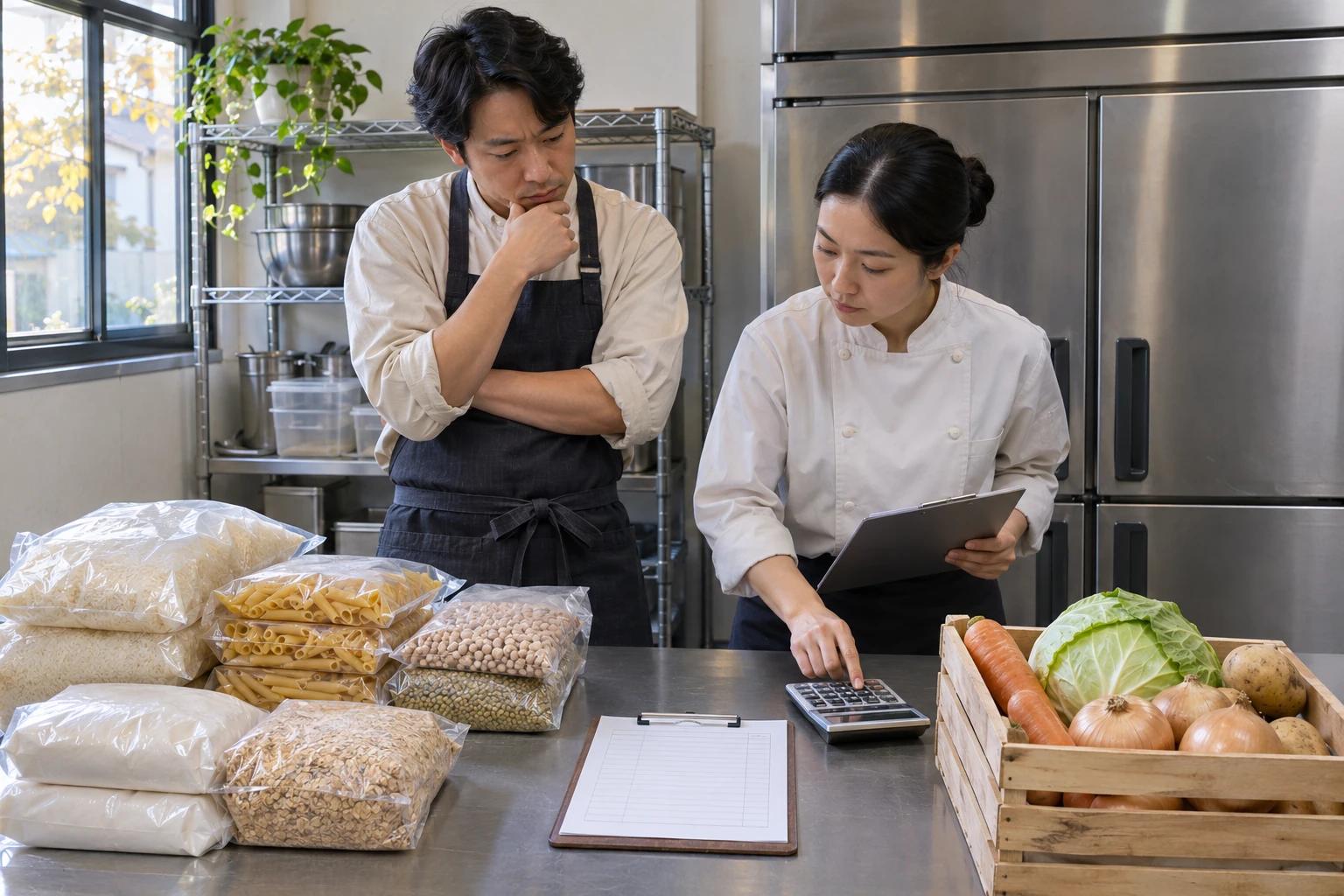
The supplier asks how many cases you want. You look at the menu, then at the refrigerator, then back at the order form.
Ordering more feels reassuring. Running out on the first day sounds embarrassing. But every extra case needs money, storage, and a realistic plan for use.
This is a hypothetical ordering scene, not a real owner's experience or a forecast for a particular restaurant. It captures the decision facing a new operation: you need to buy before you have the sales history that would make buying easier.
Yesterday, we decided which work early employees would cover and how to teach it. Now that team needs ingredients. The useful opening order connects the customers and menu you tested with the service capacity, cash, and food-safety arrangements you have prepared.
Choose a planning period before choosing a quantity
Start with the period the order needs to cover. When is the next dependable delivery? What is the supplier's order cutoff? What happens if an item is unavailable? When may the facility receive food under its opening approvals?
An order covering two services is a different decision from one covering an uncertain week. Ask suppliers about minimum orders, pack sizes, delivery charges, lead times, substitution policies, and payment terms. Get the actual arrangements rather than assuming an emergency top-up is available.
Write the next ordering decision on the calendar. You are planning until that point, with any justified reserve, rather than trying to eliminate uncertainty for the entire opening month.
Make a low, working, and high demand scenario
Use evidence you actually have: lawful food-test results, committed orders, nearby customer routines, proposed hours, and any reservations or preorders whose terms and status are clear. Keep confirmed commitments separate from expressions of interest.
Then sketch plausible scenarios. In an invented one-service example, a small counter might examine 40, 80, and 120 main-item orders. Those numbers are teaching assumptions, not typical opening sales.
Ask what each scenario means for the team. If the kitchen cannot safely produce 120 orders during that service, buying ingredients for 120 does not create the missing capacity. You may need a smaller opening scope, controlled order availability, or a clear limit on what can be offered.
Do not assign probabilities merely to make the worksheet look scientific. Record why you chose the working case and what would make you revise it.
Forecast menu choices, then ingredients
Total orders do not tell you how much of each dish customers will choose. Estimate the menu mix using your test evidence, while marking where the assumption is weak.
For each recipe, record a consistent portion and the quantity of every ingredient in the form you will use it. Distinguish raw, trimmed, cooked, and ready-to-serve weights. A purchase weight is not automatically an edible portion.
The USDA Food Buying Guide distinguishes purchase units and edible-portion yields, and explains how servings relate to quantities purchased. It is designed for child nutrition programs; the useful concept here is unit and yield discipline, not a recommended adult restaurant portion or a guaranteed yield for your recipe.
Test your own products and preparation methods. Record the measurement stage so the next employee can reproduce the calculation.
Work through one ingredient without hiding the assumptions
Here is an entirely hypothetical vegetable-order calculation, independent of any real menu. Assume the premises may lawfully receive and store the food, and the trained lead has established its safe handling and usable life.
Planning stepInvented assumption or calculationWorking sales plan80 main-item orders for the periodShare choosing this vegetable component60%, giving 48 portionsReady-to-serve portion4 ounces, giving 192 ounces or 12 poundsMeasured usable yield from purchased form80%Purchase-form quantity needed12 ÷ 0.80 = 15 poundsUsable on-hand stock in the same purchase form3 poundsConfirmed incoming stock before useNoneNet quantity to buy before case rounding15 − 3 = 12 poundsSupplier pack size5 poundsOrder if buying whole packsThree packs, or 15 pounds
The order adds three pounds beyond the calculated net need because of pack size. Combined with on-hand stock, there are 18 purchase-form pounds. At the assumed yield, that is 14.4 ready-to-serve pounds: enough for 57.6 four-ounce portions on paper, rather than the planned 48.
That extra amount is a consequence of the pack, not evidence that more customers will arrive. Ask whether a smaller pack, split delivery, or safe planned use elsewhere makes sense. Do not add another automatic percentage reserve without noticing that you already rounded upward.
For each ingredient, the planning relationship is: needed purchase-form quantity, plus an explicitly justified reserve, less usable on-hand stock and confirmed incoming stock, then adjusted for pack size. Count each quantity once and use matching units. Stock already reserved for another commitment is not freely available.
Put the calculation against the room and the bank balance
Before approving the order, check where each item will go. Include receiving space, refrigeration, freezer and dry-storage capacity, separation requirements, and space needed for prepared batches. An empty shelf in a photograph is not a capacity assessment.
For California facilities, the 2026 California Retail Food Code governs approved sources, receiving, storage, and temperature control. Apply the relevant requirements with your local enforcement agency and trained food-safety lead. This arithmetic does not determine whether stock is safe or how long it may be kept.
Then total the actual invoice, delivery charges, and payment dates. Carry the amount into the cash forecast. A lower price per pound may still require more cash now and leave more product than you can use safely.
Keep expensive, short-life, or single-menu-use ingredients visible in the review. Those deserve a more deliberate decision than a low-cost shelf-stable item with several planned uses.
Order ingredients and prepare batches as separate decisions
Buying enough ingredients for a service does not mean cooking or assembling every portion before it starts.
Set an initial preparation quantity and a trigger for the next batch, based on safe production methods, lead time, staffing, and observed demand. Have the trained lead confirm that the proposed batching fits your reviewed operation, including any holding, cooling, or reheating process.
Smaller batches can help limit surplus, but only if staff can replenish them safely and in time. A plan requiring a new batch every few minutes may simply move the forecasting problem into the busiest part of service.
Identify who may change the preparation plan and who updates the order channels if an item becomes unavailable.
Make the first count useful for the second order
Count what arrived and what remains using consistent units. Record sold portions, staff meals, test batches, approved donations, waste, transfers, and any discrepancy separately. Note the time an item sold out.
The EPA's wasted-food assessment resources offer tools for measuring amounts, types, and sources of waste. Begin with a practical log the team can maintain; do not wait for a sophisticated system before recording why food was lost.
Review the assumptions before the next cutoff. Did customers choose a different dish? Was the portion inconsistent? Did an opening promotion create a service that should not be treated as an ordinary Tuesday?
Return to the supplier's question. You may still not know precisely how much customers will buy. You should be able to explain the order, where it will go, which assumptions it uses, and when you will revise it.
The companion article takes up what happens when reality differs: an empty pan too early, or too much food left at closing.
If you already run a business and want to see how findable it is today, YupUp offers a free SEO audit.
Sources
- USDA Food and Nutrition Service, About the Food Buying Guide — purchase units, edible portions, and yield calculations; child-nutrition program context.
- California Retail Food Code, effective January 1, 2026, hosted by Orange County Health Care Agency — California sourcing, receiving, storage, and handling framework.
- U.S. EPA, Resources for Assessing Wasted Food — measurement and tracking tools.
Need a review and local marketing system?
YupUp helps independent businesses manage reviews, local visibility, and customer follow-up with AI-assisted workflows.
Get a free growth review