
So This Is Ownership: Build Food-Safety Habits Your Team Can Follow During a Rush
A queue changes how the kitchen feels. Put clear checks, accessible tools, and correction decisions into the work before speed tempts people to improvise.
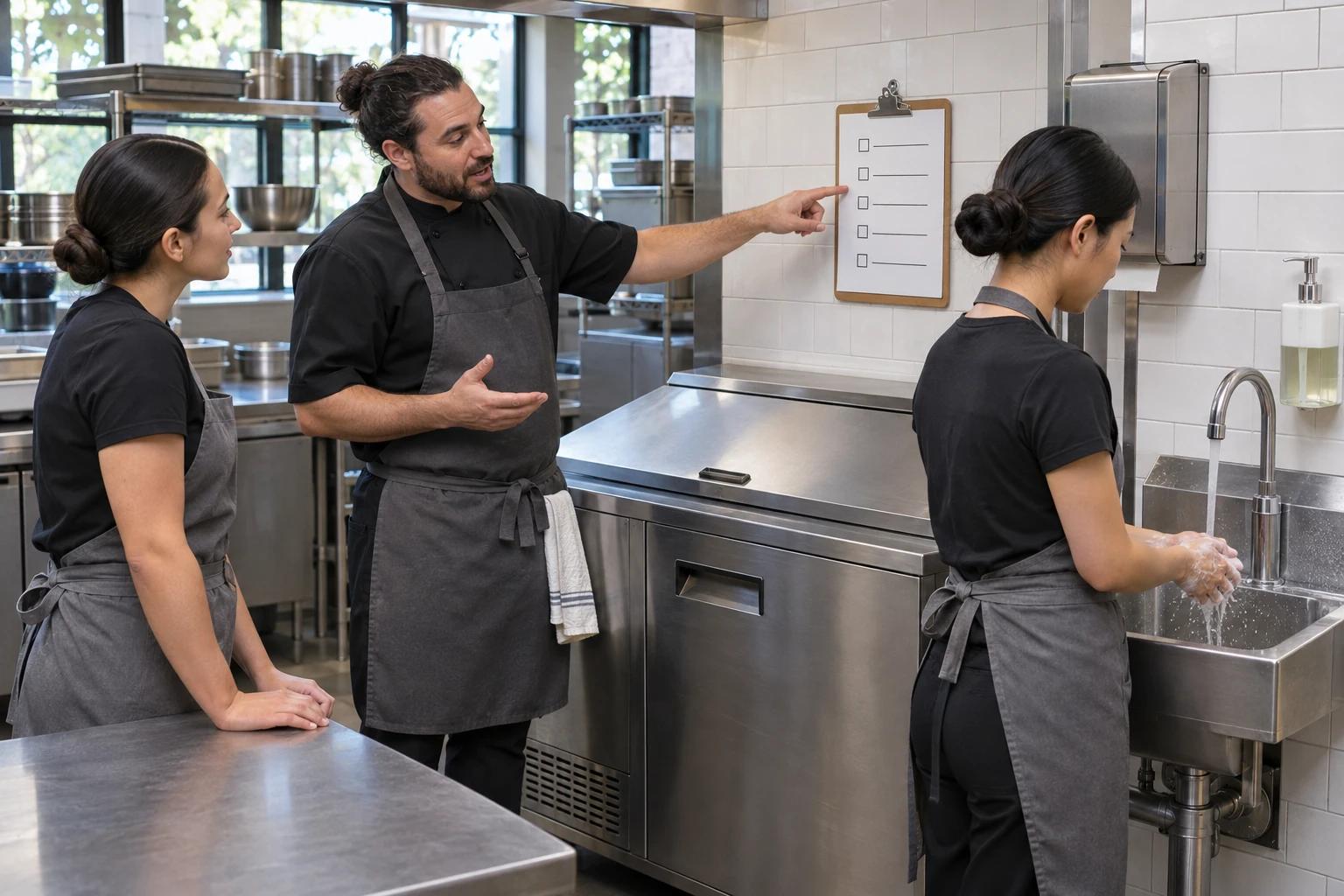
Three order tickets arrive together. A courier is waiting. Someone asks for more packaging, and a teammate moves from clearing a dirty tray toward the assembly station.
The safe next step needs to be obvious even while everyone is thinking about speed.
This is a hypothetical service scene, not an observation of a real restaurant. It illustrates why a food-safety policy cannot live only in a binder. It needs to describe work people can carry out when attention is divided.
Today's first article prepared the restaurant for its first health inspection. This one prepares the shift that follows. The aim is to make safe decisions part of the ordinary job, with someone responsible for checking that the system actually works.
Turn “be careful” into an action someone can observe
Start with one menu item and the actual route it follows through the kitchen. Identify the points where a mistake could affect food safety, then write a short instruction for each point.
A useful station instruction answers: who acts, when, what they check, which limit or procedure applies, and what they do if it fails. Add where the result is recorded when a record is useful or required.
For example, “keep food cold” gives a new employee little help. A complete procedure identifies the foods, equipment, measurement method, checking schedule, operating limits, and person to call. Have your trained food-safety lead establish those details using applicable law and the operation's reviewed procedures.
This is the practical purpose of active managerial control. FDA's management guidance describes a preventive system using procedures, monitoring, training, verification, and corrective attention. It is model guidance, not proof that a particular FDA edition is the law in your locality.
Build a short routine around changes in the work
Use the real shift to choose checking points: before service, at receiving, when food is prepared or transferred, during holding, when tasks change, and at handoff or closing. An opening check cannot tell you everything that happens at lunch.
Here is an original routine-design worksheet, not an official HACCP plan or a complete compliance schedule:
Work momentDefine the checkDecide the response in advanceBefore serviceRequired facilities, tools, supplies, and equipment readyResolve missing essentials before affected work startsReceivingSupplier, condition, and applicable food temperaturesTrained lead decides acceptance or rejection under the procedureCooking or reheatingProduct-specific time/temperature processContinue, hold, or discard only under the established corrective procedureHolding and coolingApplicable food measurements and elapsed timeStop affected use and have the lead evaluate documented historyTask changeHandwashing, clean tools, and protected foodReset the station before the next taskShift handoffOutstanding problems and time-sensitive batchesNamed incoming person accepts responsibility
Assign a primary person and backup for each task. If everyone is responsible in theory, a busy shift may leave nobody responsible in practice.
Put the right temperature instruction beside the task
For California restaurants, the 2026 California Retail Food Code is the governing state framework, applied by the local enforcement agency. Do not substitute a consumer leftovers rule or a generic internet chart for the procedure your menu requires.
As a local reference, Alameda County's holding guidance uses cold holding at 41°F or below and hot holding at 135°F or above. These are holding limits, not cooking temperatures. Confirm food-specific exceptions and any permitted alternative control with your enforcement agency.
For potentially hazardous food after heating or hot holding, California section 114002 specifies cooling from 135°F to 70°F within two hours, and to 41°F or below within six hours total. It is not six additional hours after reaching 70°F. Other cooling situations have different provisions.
Give cooking, reheating, and cooling their own instructions. The foods and processes differ; this article intentionally does not offer one temperature for all cooking. Have the lead establish the correct limits and methods for each menu process before training staff.
A refrigerator display reports the equipment's reading; it does not replace appropriate food-temperature checks. Make suitable thermometers accessible, train staff to use and verify them under the applicable procedure, and keep probes clean and sanitized.
A failed check needs a decision, not a nicer number
Suppose a hypothetical check finds a food outside its required holding range. Writing the result down and turning the thermostat lower does not establish that the affected food is safe.
The employee should stop affected use and notify the designated lead. That person evaluates the measured temperature, documented time/history, and the established corrective procedure, seeking regulator guidance when needed. If safety cannot be established, do not serve the food. Discard when required; do not invent a new time allowance or assume recooling or reheating always makes food safe.
Set checking frequency with your trained lead so there is a realistic opportunity to detect problems and respond within the applicable limits. Record the actual observation and action. Never fill in a missed check from memory or alter a reading to make a log look complete.
The useful record explains what happened, what was done, and who verified the result.
Make task changes the cue for handwashing
Trace a worker moving between a phone, dirty equipment, raw ingredients, and ready-to-eat assembly. Where does each transition require a reset?
CDC's restaurant handwashing research supports making handwashing practical through accessible facilities and workable routines. Keep the dedicated sink stocked and unobstructed. Teach the actual technique and required occasions, and observe staff demonstrating them.
Gloves do not replace handwashing. CDC's guidance for food-service workers recommends utensils or gloves to avoid bare-hand contact with ready-to-eat foods. Train employees on proper use and changes under local requirements; the same gloves should not carry contamination from one task into the next.
If the workflow makes the safe transition difficult, change the workflow. A supervisor rushing someone past a required step teaches a stronger lesson than a poster beside the sink.
Teach cleaning as a sequence, not a quick wipe
Write the appropriate cleaning and sanitizing procedure for each surface or item, including when to perform it, supplies, and verification. For a typical washable food-contact item, the sequence includes cleaning, rinsing, sanitizing by the approved method, and air drying. Equipment-specific instructions and local requirements still apply.
For chemical sanitizers, follow the approved product's label and applicable code for concentration, contact time, and conditions. Provide the correct testing materials and teach staff to use them. California section 114107 requires testing equipment/materials appropriate to the sanitization method and accurate determination of chemical concentration. “It smells strong” is not a measurement.
Allergen control needs explicit attention too. FDA research on allergen removal found that wiping and cleaning effectiveness depends on several conditions; a casual wipe is not a universal solution. Establish a reviewed process, keep ingredient information current, and assign allergy questions to someone who can check the facts. If the team cannot verify a customer's request can be accommodated, say so rather than promising an allergen-free meal.
Make reporting illness workable
Give employees a clear reporting route before they arrive for work. Identify who applies the illness policy and who organizes coverage. Do not make the person reporting symptoms decide alone whether the kitchen can spare them.
The FDA Employee Health Policy Tool helps structure discussions about restriction and exclusion, while expressly requiring users to follow their applicable health codes. Use a locally appropriate policy, including reporting and return-to-work requirements. A generic symptom list is not medical clearance.
Rehearse a rush and watch what disappears
Before service is authorized, rehearse with empty containers and order cards. Add interruptions: a late delivery, a tool needing cleaning, a questionable ingredient, and a task handoff. Ask the observer which checks were delayed or forgotten.
Then improve one thing at a time: move the thermometer, simplify a station card, change the handoff, or assign a backup. Use words and languages staff understand, and have them demonstrate the procedure back to the trainer.
If real demand later exceeds what the team can handle safely, slow or pause affected orders, simplify service within the approved operation, or stop affected production. Safety checks cannot become optional capacity.
Return to the imagined tickets. The queue is still there. The difference is that the team knows the next safe action and has permission to take it.
Tomorrow we move into hiring and training: who you need first, and how to teach the work before customers depend on it.
If you already run a business and want to see how findable it is today, YupUp offers a free SEO audit.
Sources
- FDA, Food Code 2022, Annex 4 — active managerial control as educational management framework; not asserted as current local law.
- California Retail Food Code, effective January 1, 2026, Orange County Health Care Agency-hosted copy — sections 114002 and 114107, plus cleaning/sanitizing framework.
- Alameda County Environmental Health, Delivery Food Safety — local holding-temperature reference; consumer leftovers advice is not used as an operating corrective rule.
- CDC, Food Worker Handwashing in Restaurants and Food-Service Worker and Manager Guidance — handwashing and prevention practices.
- FDA, Allergen Removal and Transfer Using Wiping and Cleaning Methods — conditions affecting allergen removal and transfer.
- FDA, Employee Health Policy Tool — policy development and local-code qualification.
Need a review and local marketing system?
YupUp helps independent businesses manage reviews, local visibility, and customer follow-up with AI-assisted workflows.
Get a free growth review