
So This Is Ownership: The Equipment Decisions That Follow You Into Every Shift
The purchase price is visible today. Installation, cleaning, energy use, repairs, and the way an appliance fits your service will keep showing up after the invoice is paid.
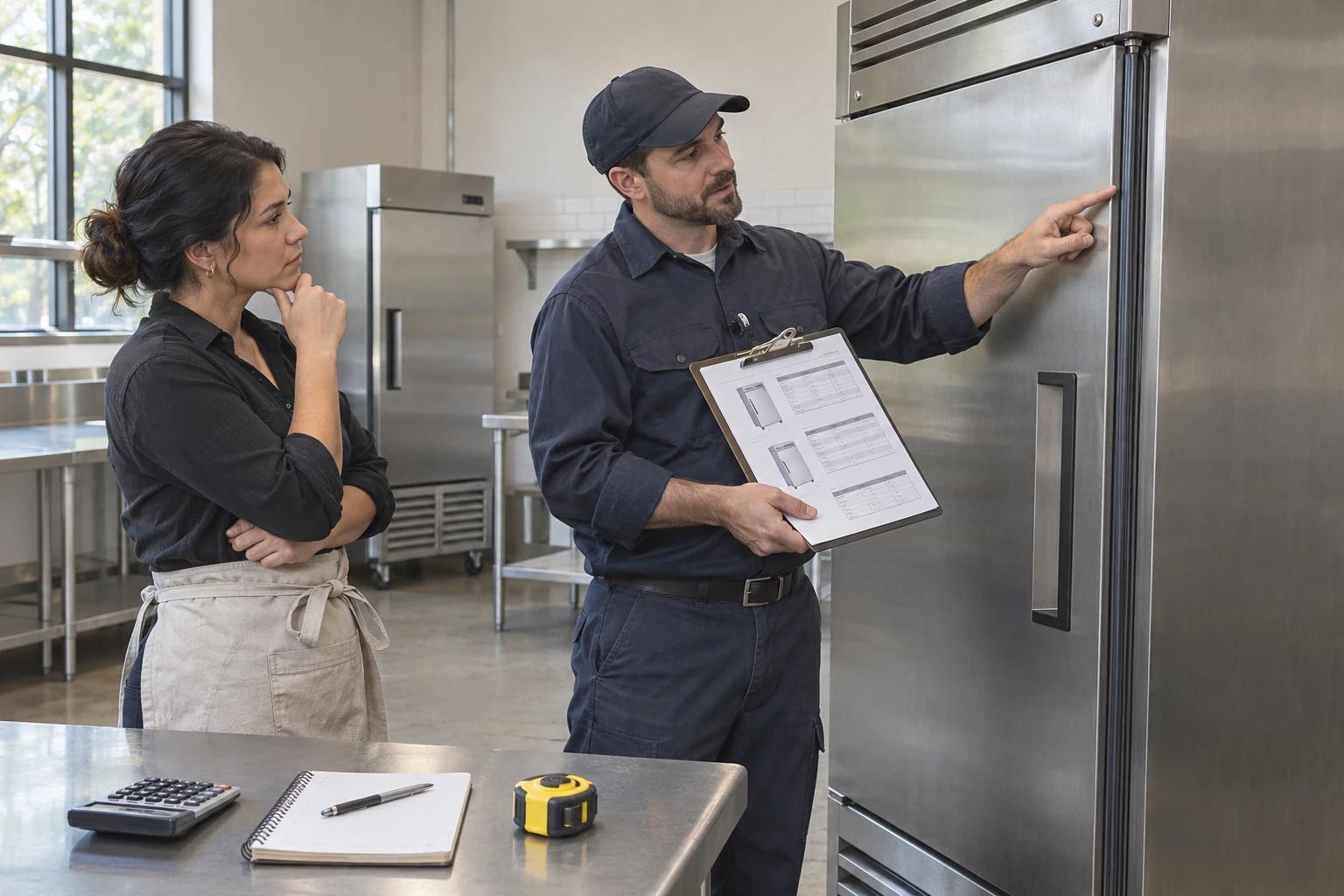
The used refrigerator looks like a bargain. The shelves are clean, the exterior shines, and the seller says it is ready to go.
You compare its price with a new model. Then another question interrupts the calculation: who will repair it if it stops working during your busiest week?
This is a hypothetical purchase decision, not a review of a real appliance or seller. It captures what an equipment price tag leaves out. The purchase happens once; the consequences appear during receiving, service, cleaning, and closing.
Today's first article designed the kitchen around the work. Now use that work to choose the equipment. The right comparison starts with the job you need done and continues through installation, daily use, and service support.
Give every major purchase a job description
Before choosing a model, write a short requirement in operational terms.
For refrigeration, describe what must be stored, in which containers, how deliveries arrive, and how employees retrieve ingredients. For cooking equipment, describe the menu tasks, batch sizes, and service pattern. For warewashing, identify the utensils and containers that come back and how they are returned to use.
Avoid choosing capacity from one headline number. Ask a supplier or manufacturer to demonstrate the model with your intended pans, racks, or containers. Compare the task it can perform under relevant conditions with the work you expect during service.
For example, a hypothetical counter plans to assemble 30 orders during a busy half-hour. If 18 of those need the same cooked component, investigate how that component will be produced, replenished, and incorporated into those orders. A claim about an appliance's maximum output does not resolve the preparation, handling, assembly, and staffing steps around it.
Record assumptions from the demonstration, including portion, batch, recovery time, and operator involvement. Do not turn a sales demonstration into a guaranteed service capacity.
Clear three different questions before ordering
Equipment needs to be suitable for the job, acceptable to the relevant authorities, and compatible with the building. An answer to one does not settle the others.
In Alameda County, California, the plan-review FAQ says new and replacement food- and utensil-related equipment must have sanitation certification or classification through an ANSI-accredited program; where no applicable standard exists, the department evaluates approval. Ask the reviewer what documentation applies to the actual model.
NSF's food-equipment standards overview illustrates that sanitation standards address matters such as equipment materials, design, construction, and performance. A general safety mark or a seller's description of an appliance as “commercial” is not the same evidence as its applicable sanitation listing.
Energy efficiency is a separate comparison. ENERGY STAR's commercial-kitchen resources provide product, specification, calculator, and rebate-finding tools. Those resources can help you compare energy and water implications; they do not establish permission to install a model in your restaurant.
Keep all three questions visible in the purchase file rather than looking for one label that appears to answer everything.
Check the delivered and installed equipment, not just the box
Have the designer and appropriate licensed trades verify utility requirements, connections, ventilation, drainage, clearances, and the proposed location. Use the current model specifications and installation instructions.
Measure the delivery route as well as the final footprint. Can the unit pass through the entrance and turns? Where will unloading happen? Who handles rigging, installation, startup, and removal of old equipment?
Alameda County's food-facility plan requirements call for equipment documentation coordinated with the plans. Its plan-check guide addresses cooking equipment and ventilation together. Do not assume an electric appliance, a countertop model, or an existing hood removes the need for review.
Get a written installed-cost scope. Ask what is excluded, which approvals are prerequisites, and who is responsible if the model changes. An inexpensive unit needing substantial building work may produce a very different decision from the price you first compared.
Ask someone to show you the cleaning routine
During a demonstration, ask how the equipment is shut down, made safe, cleaned, reassembled, and returned to use according to the manufacturer's instructions.
Which parts come out? Where will they be washed and dried? Can employees reach the relevant surfaces after the unit is installed? What tools, supplies, and time does the routine require?
Do not improvise maintenance or bypass guards to make the demonstration easier. Ask the manufacturer or qualified service provider which tasks staff may perform and which need a technician.
The County's plan-check guide also addresses access for cleaning around installed equipment. Carry that concern from the first article's floor plan into the model selection.
A difficult cleaning routine is work you are assigning to someone on every relevant shift. Include it in the staffing and training plan rather than leaving it outside the purchasing decision.
Compare a defined period of ownership
Use the same time period and assumptions for each option. Separate purchase, delivery, installation, operating costs, planned maintenance, and uncertain repairs. Keep financing cash flows separate so you do not count the purchase price and loan principal twice.
Here is an invented comparison of two unspecified commercial units in U.S. dollars. It is not a quote, market benchmark, or verified energy-savings claim. Both units are assumed to meet the same required task; that assumption would need evidence in a real purchase.
Modeled itemOption AOption BPurchase, delivery, installation, and startup$5,400$6,500Annual energy and water$1,500$1,200Annual planned maintenance$300$250Three-year modeled total$10,800$10,850
The totals are upfront cost plus three times annual operating and maintenance costs. They exclude tax, financing, unplanned repairs, downtime, disposal, resale value, and changes in utility rates.
Under these assumptions, Option B costs $1,100 more upfront and $350 less each year to operate and maintain. At three years, the modeled difference is only $50 in A's favor. A small error in an estimate could change that comparison.
The worksheet has not chosen a winner. It has shown which assumptions deserve better evidence and whether you can afford the upfront cash. Use model-specific data, local utility rates, and your expected operating pattern. Treat a rebate as conditional until eligibility, timing, and payment requirements are verified.
Give used equipment a proper investigation
For a used unit, obtain the exact model and serial number, service history if available, current condition, included parts, and written sale terms. Have a qualified technician assess it and ask the authority about acceptance for the proposed installation.
Clarify any warranty, who provides it, what it excludes, and how a claim is handled. Ask about parts availability and service coverage for that particular model. Missing records are uncertainty to account for, not proof that something is wrong or that it is a bargain.
Apply the same questions to a new unit. “New” does not tell you local repair response, installation completeness, warranty conditions, or whether the equipment fits your workflow.
Decide what happens when it is unavailable
Identify the appliances whose loss would stop the main menu. Ask what safe, approved operating options remain if one is unavailable. You might be able to offer a smaller menu, rearrange production within the approved operation, or need to stop affected service.
Do not assume a rental, substitute appliance, or different preparation method can be introduced without checking the relevant requirements. Alameda County's Plan Review program includes equipment installation, replacement, and modification.
Keep supplier contacts, service arrangements, model details, and operating manuals where the responsible team can find them. Build a plan for protecting food and responding to failures with your food-safety adviser; tomorrow's installment moves further into those habits.
Make the purchase file explain the decision
Before authorizing a major order, gather the task requirement, exact model, acceptance documentation, coordinated installation plan, installed-cost quote, service terms, cleaning routine, and cancellation or substitution conditions.
Mark each unresolved item with an owner and a next action. If the equipment is long-lead, ask the designer, supplier, and reviewers how to manage the timing without treating an unapproved substitution as a harmless change.
Return to the imagined refrigerator. The useful question is no longer whether its sticker price looks attractive. It is whether the unit, installation, service support, and daily routine fit the operation you can actually fund and run.
That decision follows you into every shift. Next, we turn to the first health inspection—and the food-safety habits that need to exist before the first customer order.
If you already run a business and want to see how findable it is today, YupUp offers a free SEO audit.
Sources
- Alameda County Environmental Health, Plan Review FAQ — sanitation certification and department evaluation where no applicable standard exists.
- NSF, Food Equipment Standards — scope of sanitation standards; not site approval.
- ENERGY STAR, Commercial Kitchen Equipment Tools, Materials and Resources — product, efficiency, calculator, and rebate research tools; savings require model-specific assumptions.
- Alameda County Environmental Health, Plan Requirements, Plan Check Guide, and Plan Review — coordinated equipment documentation, ventilation, cleaning access, and review scope.
Need a review and local marketing system?
YupUp helps independent businesses manage reviews, local visibility, and customer follow-up with AI-assisted workflows.
Get a free growth review