
So This Is Ownership: Where the Money From One Customer’s Order Actually Goes
A customer pays for lunch, but the payment is not yours to keep. Follow one hypothetical order through discounts, food, packaging, fees, and labor before deciding what remains.
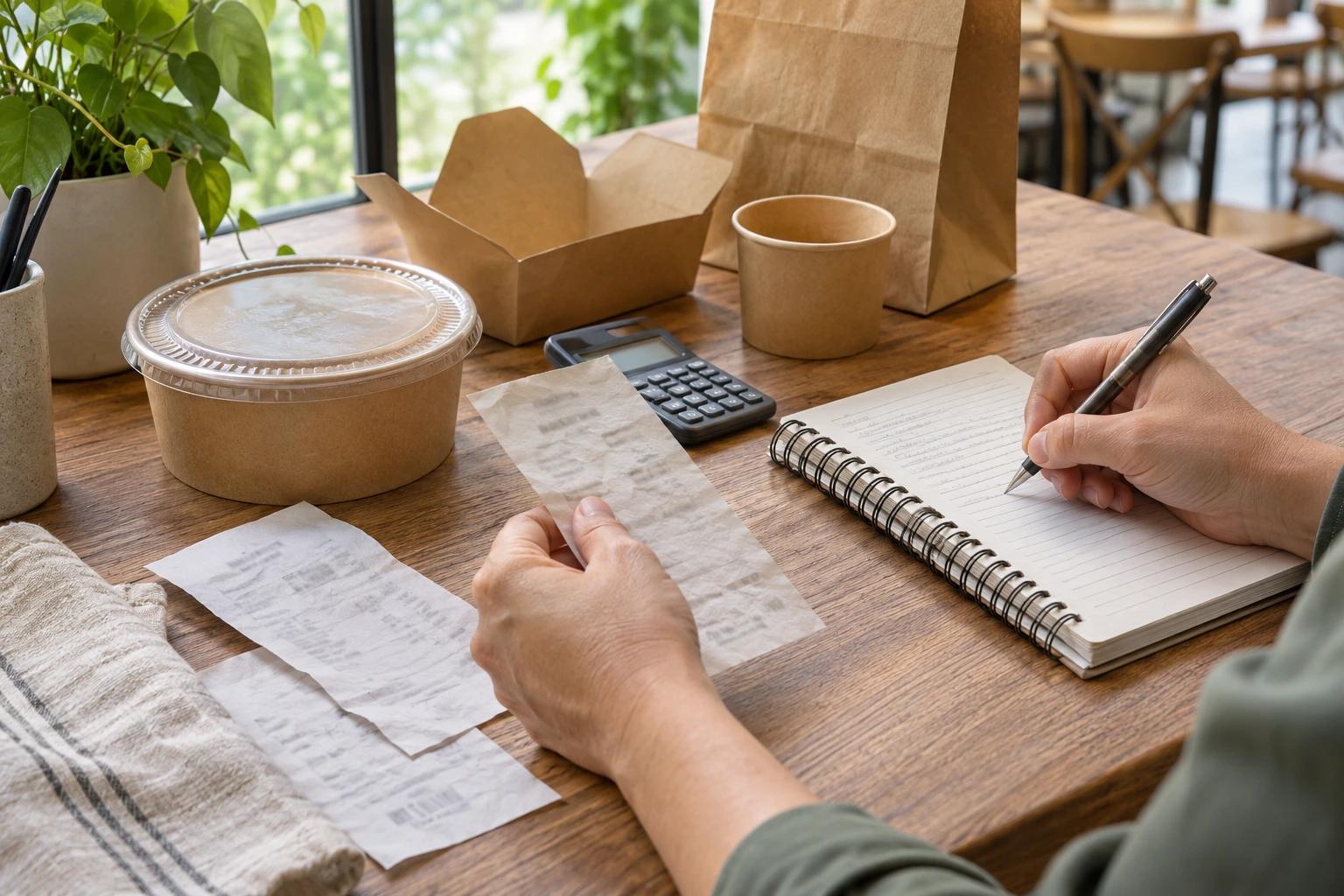
Where the Money From One Customer’s Order Actually Goes
The lunch leaves the counter in a paper bag. The customer has paid, the order is complete, and the next ticket is waiting.
Later, you check the payment report. The amount deposited does not look like the number on the menu. There was a discount, a processing charge, and other money passing through the transaction. Meanwhile, the supplier receipt is still in your jacket pocket.
This is a hypothetical scene, not an account of a particular restaurant or payment provider. It is a useful place to slow down. Before multiplying orders into a monthly forecast, learn what one order contains financially.
In today's first article, we used a simplified $16 meal with $8 of variable costs. Now we will open that example, then introduce a $1 business-funded discount. All amounts below are invented teaching figures. They are not typical costs, provider prices, local wages, or a recommended menu price.
Start with the sale, then reconcile the payment
Keep these records separate: the menu price, the amount earned after discounts or refunds, money collected for other purposes, transaction charges, and the eventual deposit.
For our simple direct-collection example, the menu price is $16. A $1 discount funded entirely by the restaurant reduces the meal revenue to $15. Assume no refund and no reimbursement from anyone else. Sales tax and tips are excluded from all example figures.
That last sentence matters. Do not treat a customer's entire card charge as money available to pay food costs. Identify tax, tips, fees, reimbursements, and other adjustments in the transaction report and review their treatment with your bookkeeper.
For California, CDTFA's restaurant guide distinguishes tax treatment for different food sales and for optional versus mandatory tips or service charges. A to-go label alone does not settle the tax question. No statewide tax rate or universal restaurant tax rule is assumed here.
If a platform or another business funds a discount, document the reimbursement and its terms instead of automatically subtracting it as your own discount. This example deliberately has no such complication.
Follow the hypothetical $15 through the order
Here is the planning sheet for one single-meal order after that discount:
LineHypothetical amountWhat it representsMenu price$16.00Listed meal price before tax and tipsRestaurant-funded discount−$1.00Reduction in what the meal earnsRealized meal revenue$15.00Starting point for this order's contribution calculationIngredients consumed, including a stated waste allowance−$4.20Food input estimate, not the entire supplier purchasePackaging used−$0.80Container, bag, and other included packagingAssumed transaction charge−$0.60Illustrative charge, not a real processor's rateVolume-related labor allocation−$2.40Assumed portion that varies with this order volumeTotal included variable costs−$8.00Sum of the four cost lines aboveContribution toward remaining costs$7.00Revenue less included variable costs; not net profit
The same order at the full $16 price would contribute $8 if those four costs stayed unchanged. Here, the $1 discount reduces contribution from $8 to $7: a 12.5% decrease in the amount left toward remaining costs. Actual transaction charges or other costs may change with price, so recompute them for your own offer.
Nothing in this table establishes that $7 is enough. Facility charges, scheduled staffing not included above, insurance, administration, owner work, and other commitments still need an answer.
Cost the ingredients you use, not just the shopping trip
Suppose, in a separate hypothetical purchasing example, you spend $40 on ingredients and use only part of them in the trial. Charging the entire $40 to one order would confuse a purchase with consumption. Ignoring the remainder that spoils would understate the cost of the operation.
Build an ingredient sheet using actual purchase units, usable quantities, recipe quantities, and measured batch yield. Include sauces, garnishes, cooking inputs, and portions served. Check that grams, ounces, packages, and portions are converted consistently.
For an ordinary costing exercise, a $42 batch that genuinely provides ten sellable portions has a $4.20 ingredient cost per portion. If the batch yields only eight, it is $5.25 before any other costs. Those are arithmetic illustrations, not recipe or food-safety guidance. Use actual measured yields under appropriate conditions.
Record waste and explain where you include it. The $4.20 line in our main table already assumes a waste allowance. Do not add the same waste again elsewhere. Compare planned usage with actual usage over a period and investigate differences before adjusting the recipe sheet to make the numbers look better.
The later inventory installments will go deeper into purchasing and waste. Today's task is to make the cost assumption traceable.
Give packaging and fees their own lines
An empty container on the counter can look insignificant. Repeated across orders, it deserves a dated unit cost just like an ingredient. Include the pieces actually used for that offer, and distinguish a minimum purchase from cost consumed per order.
For fees, read the actual agreement and statements. Ask which charges are per transaction, percentage-based, monthly, channel-specific, or associated with refunds and other events. This article makes no claim about a provider's fee schedule.
Avoid double counting. If you start from sales before the processing deduction, subtract the relevant processing fee once. If you begin from a deposit that already reflects it, first reconstruct the sale and adjustments. Otherwise, it is easy to subtract the same charge twice.
A bank deposit is useful evidence of cash movement. It does not replace the order report, fee statement, and sales record.
Decide where labor belongs before dividing it
The $2.40 line is a simplified assumption about labor that varies with order volume. It is not a statement that a restaurant pays someone only when an order arrives.
In your operation, some staffing may be needed for the whole shift regardless of sales. Another portion may rise with extra work. A further worker may become necessary only above a certain volume. Identify those patterns and put each cost in the appropriate place.
Record prep, setup, service, cleanup, ordering, and administration, with the people and time required. Build the labor budget using applicable wages and employment costs for the actual jurisdiction and arrangement; do not use the hypothetical allocation as a pay rate.
If scheduled labor is in monthly costs, do not put the same hours into every order as well. If owner work is included as a separate planning allowance, explain how it relates to the hours recorded here. A clean-looking cost sheet with missing or duplicated hours is not useful.
Keep contribution separate from a share of overhead
You may want to allocate rent and other recurring costs across expected orders to see a fuller cost per order. That can be helpful, but label the allocation and its assumed volume.
Suppose a separate illustrative fixed commitment is $3,000 per month. Spread across 1,000 orders, it is $3 per order. Across 500 orders, it is $6. The bill itself has not changed; the number of orders carrying it has.
The SBA's break-even framework connects contribution to fixed costs. When using that framework, subtract fixed costs at the period level rather than subtracting an allocated share from each order and then deducting the same monthly bill again.
Keep the three views labeled: contribution per order, allocation of recurring costs at a stated volume, and period result after the included costs. Financing, tax, opening investment, and cash timing need further analysis. None is solved by renaming contribution “profit.”
Compare the order you actually sell
A bowl sold directly and a larger basket sold through another channel are different units. Compare their actual revenue, discounts, costs, and work. Do not paste a channel fee onto the table while leaving its order mix and other costs unchanged without checking them.
For a menu with several products, calculate item economics and then examine the observed or assumed mix. A popular lower-contribution item can change the average that supports the monthly model. A hoped-for add-on is an assumption until customers actually buy it.
Track a few representative order types before creating an elaborate average nobody can explain. The goal is a model you can reconcile to real transactions and update when the offer changes.
Make the cost sheet easy to challenge
Use one row per input, with these fields:
FieldWhat to put in itItem and unitExactly what the cost buys or measuresAmount and calculationQuantity, unit cost, yield, or fee basisEvidence and dateInvoice, agreement, measured trial, or clearly marked assumptionTreatmentPer order, per batch, per shift, monthly, or a step at a stated volumeInclusion checkWhere this cost appears and what prevents double countingNext reviewWhat would change the estimate or require a new quote
The IRS's recordkeeping guidance identifies sales slips, invoices, receipts, and other supporting documents as evidence for business records. Keep the calculation connected to those documents. This planning sheet does not determine tax deductions or replace complete books.
End by choosing the next question. Is the portion costing uncertain? Does a discount need testing? Is the service model missing paid time? Would a channel change the contribution enough to reconsider it?
Return to the bag leaving the counter. You can now describe more than its price: what the meal earned, what it consumed, and which costs remain. That makes the next order—and the next commitment—easier to assess.
Tomorrow in this YupUp.ai series, we move from each order to opening the business: What Will It Cost to Get the Doors Open? Then we ask whether you have also funded the months after it.
Need a review and local marketing system?
YupUp helps independent businesses manage reviews, local visibility, and customer follow-up with AI-assisted workflows.
Get a free growth review