
So This Is Ownership: People Like the Food. Can the Numbers Work?
The food earned another order. Now put the receipts beside the compliments: how many ordinary purchases would this restaurant need, and could the operation deliver them?
People Like the Food. Can the Numbers Work?
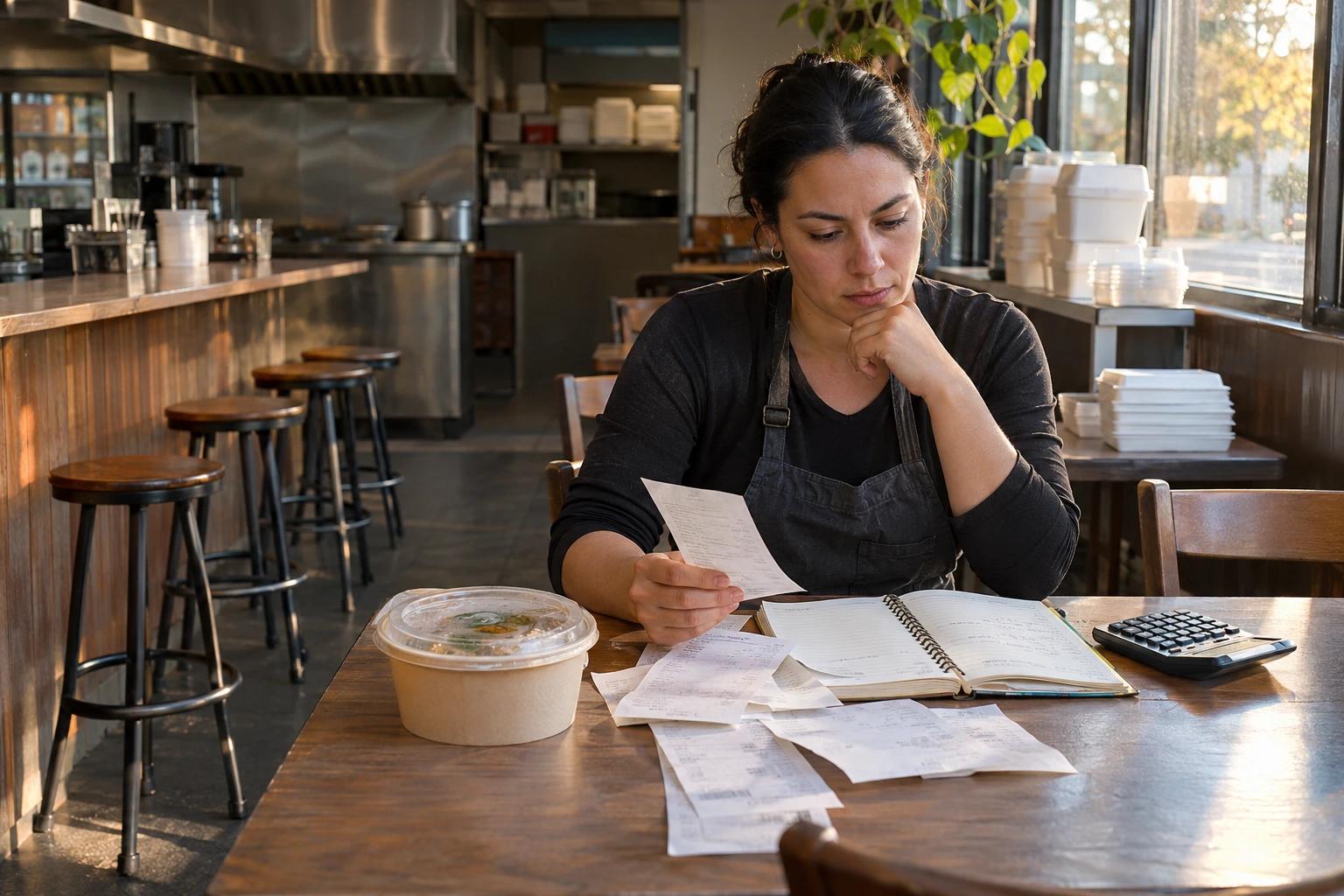
The message arrives while you are sorting receipts: someone wants to know when you will serve the lunch again.
You read it twice. Yesterday, you were wondering whether anyone beyond your friends would want this meal. Now there is a reason to keep investigating.
Then you turn over the kitchen invoice. There is the booking charge, the extra time, and the packaging you bought in a quantity much larger than the trial needed.
This is a hypothetical scene, not the results of a real food business. It brings us to the next ownership decision: can an offer people want become an operation that supports the people and commitments behind it?
On Day 18, we separated what a small food test showed from what it left unknown. Bring that record here. A compliment matters. A paid return purchase tells you something more. Neither, by itself, tells you whether the restaurant's numbers work.
Ask three different questions
Before opening a spreadsheet, write these separately:
- Demand: Who buys, at what price, on which occasions, and how often?
- Economics: What remains from those purchases after the relevant costs?
- Cash: When does money arrive, and when must payments leave?
A model can balance without evidence that enough people will buy. A service can sell every available meal while depending on unpaid work. A month can show a positive modeled result while a large bill comes due before customer receipts arrive.
Keep those questions connected, but give each its own evidence. Today, we will examine recurring operations. Tomorrow, we will investigate the money needed to open and to keep going afterward.
Start with what one order contributes
Use a clearly defined unit. For a very simple collection offer, that might be one paid order containing one meal. If buyers purchase several items, define the average order and record its mix instead of switching between customers, meals, and transactions.
From the amount earned on that order, subtract the costs that change with it. These might include ingredients consumed, packaging, relevant transaction charges, and a genuinely volume-related portion of labor. Their treatment depends on the operation; do not assume all labor moves one order at a time.
The remainder is contribution toward the costs you have not yet deducted. It is not the owner's take-home pay.
For our entirely hypothetical planning example, suppose each single-meal order earns $16, excluding sales tax and tips, and the included variable costs are $8. Each order contributes $8 toward the remaining modeled costs.
Today's companion, Where the Money From One Customer’s Order Actually Goes, will unpack that $8 and show what a discount does to the remainder. These figures are teaching assumptions, not local prices, industry norms, or a recommendation for your menu.
Put the recurring commitments underneath
List the costs that remain over the period and operating range being modeled. Investigate facility charges, scheduled staffing, insurance, software, cleaning arrangements, and other commitments. Split mixed costs where practical. Classify each cost once, with a note about what would make it change.
An extra worker required above a certain volume is a step in cost. A utility bill may contain both a base charge and usage. A kitchen booking may be fixed for one slot, then jump when another slot becomes necessary. Your model must change when the operating arrangement changes.
The SBA's break-even guidance uses fixed costs divided by selling price minus variable cost per unit. It also distinguishes mixed costs. Treat the calculation as an estimate based on the costs and assumptions included.
Our simplified example assumes $12,000 of monthly recurring requirements, fixed within the proposed operating range. This includes a stated planning allowance for the owner's work; the accountant must determine its actual accounting and tax treatment. It does not include a second deduction for labor already in the $8 per-order cost.
The arithmetic is:
$12,000 ÷ $8 contribution per order = 1,500 orders per month.
At 20 service days, that means 75 orders per day on average to cover this model's included requirements. It leaves no surplus beyond them. Financing costs, income taxes, depreciation, opening investment, and changes in working capital are outside this deliberately limited example and must be addressed in a fuller plan. Do not label the result complete accounting profit or household income.
Translate the total into a working day
“Fifteen hundred orders a month” can remain a distant number. Seventy-five a day asks operational questions.
When will those orders arrive? If most buyers need lunch in the same short window, an all-day average can conceal a service bottleneck. How many can the approved setup handle, with the proposed people, equipment, storage, collection arrangement, and safe procedures?
Imagine a separate hypothetical process trial supported 65 orders per day under comparable conditions. It would be premature to assume the operation can deliver the 75 required by the model. More demand would not remove that gap; you would need to investigate capacity, timing, the offer, or the cost structure.
Nor is measured capacity evidence that customers will fill it. Put three numbers beside each other:
Planning questionEvidence neededHow many orders must we sell?Cost model with documented assumptionsHow many orders might customers buy?Relevant purchase behavior and market research, with uncertainty visibleHow many orders can we deliver well?Appropriate trials and process evidence under comparable conditions
A credible next step addresses the weakest of the three. It does not replace a missing answer with a bigger sales target.
Change the assumptions before trusting the answer
Keep the $12,000 requirement and $8 variable cost unchanged for this sensitivity exercise. Alter only the average realized selling price, before tax and tips:
Hypothetical realized priceContribution per orderMonthly orders to cover included requirements, rounded upAverage daily target over 20 days, rounded up$15$71,71586$16$81,50075$17$91,33467
Daily targets are rounded separately; they can produce slightly more orders than the monthly minimum. All figures are illustrative.
The higher price makes the arithmetic easier only if customers still buy and the other assumptions hold. It does not prove you can charge it. The lower price makes each order contribute less, even if the menu looks busier.
Next, test other vulnerabilities using your own records: a cost increase, a different menu mix, fewer service days, lower demand, or a need for another shift. Do not quietly hold staffing constant after the workload requires more help.
If contribution is zero or negative, extra volume cannot cover the included fixed requirements under that model. Revisit the offer and costs before treating sales growth as the remedy.
Give the owner's work an honest place
Return to the ordinary Tuesday from Day 1. Purchasing, scheduling, answering questions, checking records, and closing the business still take time even when the cooking goes smoothly.
Decide which owner role the plan assumes. Record the hours and the compensation you need to investigate, then check that this amount is included somewhere appropriate in the economic plan. A business that appears workable only because your labor is left blank has not answered the life question we started with.
Keep household needs, owner compensation, business profit, and bank withdrawals distinguishable. Their accounting treatment varies with the structure and circumstances. Review the model with a qualified accountant; a planning allowance is not a statement that a payment is deductible or treated as payroll.
Finish with a decision you can defend
Create a short economics brief with a dated source beside every input:
- The offer, order unit, channel, price, and expected mix.
- Variable cost assumptions and the evidence supporting them.
- Recurring requirements, owner work, and costs that rise in steps.
- Required orders compared with demand evidence and operating capacity.
- Items excluded from the calculation and who will resolve them.
- A weaker-case scenario and the cash or time boundary for the next investigation.
Mark each input observed, quoted, or assumed. A supplier quote is stronger than a guess, but still needs its quantities, date, and terms. A food test is an observation under particular conditions, not a permanent forecast.
You may decide to simplify the menu, investigate another format, test willingness to pay, or pause. You may find a plausible path worth developing. The useful result is the reason for that decision, not a spreadsheet colored green.
Put the return customer's message beside the receipts. Keep the encouragement. Now ask what their next order would contribute—and what the operation would need to earn repeatedly.
In this YupUp.ai series, that is the bridge from testing an idea to considering a larger commitment. First, let us follow one order's money through the business.
Need a review and local marketing system?
YupUp helps independent businesses manage reviews, local visibility, and customer follow-up with AI-assisted workflows.
Get a free growth review