
So This Is Ownership: A Food Truck, Takeout Counter, or Dining Room: What Changes Behind the Scenes?
The same lunch idea can become three different operations. Follow preparation, setup, ordering, handoff, and closing to see which responsibilities each version would put into your week.
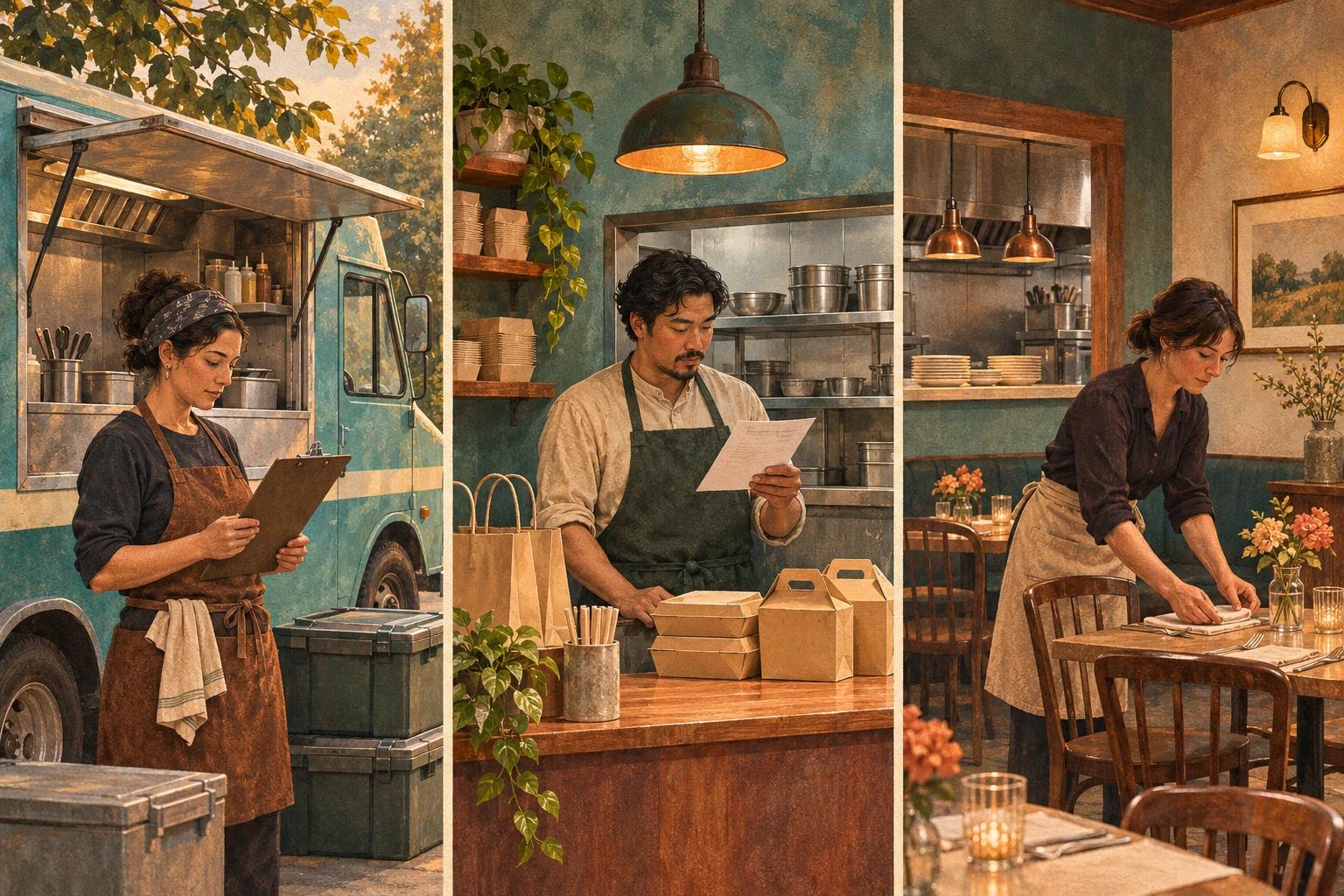
The food truck’s service window is still closed. At a takeout counter, an order sheet waits beside a stack of containers. In a dining room, someone checks the tables before customers arrive.
From outside, all three places might be described as serving lunch. Inside the plan, they create different questions about where the work happens, how it moves, and who makes the next decision.
These are hypothetical scenes, not observations of real operators. We will use three deliberately defined examples to compare the work. They are research prompts, not claims that every business in a category operates the same way.
Today’s first article set the criteria for a restaurant that could fit your life. Now put those criteria beside the operation rather than choosing from its appearance.
Define the versions before comparing them
For this exercise, the mobile version serves a limited lunch offer from a truck at a proposed trading location, with preparation and support arrangements still to be established. The takeout version serves a limited offer from fixed premises, with counter ordering and collection. The dining-room version serves lunch at tables, with staff coordinating the guest’s visit.
No menu, price, site, service hours, required permissions, or demand is established. Tomorrow we will examine the customer and menu questions more closely.
These versions are not exhaustive. A counter may also have seating. A dining room may sell takeout. A mobile operator may have a different service model. If you combine channels, map the additional work rather than assuming it fits inside the original plan.
The truck: follow the operation before it reaches the customer
In the fictional mobile version, ask where the vehicle begins the day, what must be ready before it travels, how it reaches the proposed location, and what needs to happen before service can start.
Map preparation, stock and equipment arrangements, travel, setup, service, close-down, and the appropriate destination afterward. Identify which steps depend on another facility, agreement, person, or permission. Do not assign a duration until you have suitable evidence.
Mobility is part of the setting. It does not establish that the business can trade wherever the owner chooses or that the day ends when the window closes.
For a concrete local example, Alameda County Health’s mobile-food FAQ includes commissary-agreement and route-sheet documentation. It says commissary or commercial-kitchen suitability involves a current environmental-health permit and adequate services. This is Alameda County, California guidance, not a universal rule for all mobile operations or evidence that a listed facility has availability for you.
Use the relevant regulator to establish what applies to your vehicle, proposed food activity, support arrangement, and location. Investigate trading-location permissions separately as needed for the actual proposal. A general comparison article cannot settle them.
The counter: examine how orders reach the right person
In the fictional takeout version, customers choose and collect at fixed premises. Follow an order from the customer’s decision through preparation, checking, packaging, and collection.
Ask how the order is identified, how a change reaches the people doing the work, where a customer waits, and how the correct order reaches the correct person. Those are process questions, not instructions about food handling.
If you later add online orders or a delivery provider, draw that route separately. Ask who monitors it, how the promise reaches the kitchen, and what happens when several channels need attention together. Do not count an extra channel as extra receipts without also investigating its work and costs.
The proposed absence of a dining room changes the service design. It does not answer questions about preparation, premises, customer communication, cleaning, records, or staffing. Identify those tasks in the actual counter proposal.
The dining room: follow the customer’s whole visit
In the fictional dining-room version, the experience continues beyond receiving the meal. Map arrival, seating, ordering, communication with preparation, service, questions during the visit, payment, departure, and getting the setting ready for the next guest.
The appeal may be hospitality: a room people enjoy and a chance to give attention over a longer visit. Ask whether you also want to coordinate the people and routines that would support it.
Which decisions sit with the person serving the table? Which need someone else? What happens when a customer asks a question that requires verified information? How does an expected service delay become a clear update rather than a guess?
Use a paper walkthrough to identify gaps. Appropriate training, qualified guidance, and the actual local requirements need to establish the real operating procedures. A smooth hypothetical sequence is not proof of readiness.
Put the hidden work side by side
The table summarizes the fictional versions only. Each cell asks for evidence rather than providing an industry forecast.
Question
Proposed truck
Proposed takeout counter
Proposed dining room
What surrounds service?
Support facilities, travel, setup, and close-down to investigate
Preparation and an organized order-to-collection process
Preparation plus coordination of the guest’s visit
What setting must work?
Vehicle, support arrangements, and permitted trading location
Suitable premises and customer collection flow
Suitable premises, preparation, seating, and service flow
What handoff needs clarity?
Customer order to preparation to service window
Order information to preparation to checked collection
Guest request to service staff to preparation and back
What limits capacity?
Establish it from the actual proposed operation
Establish it from the actual proposed operation
Establish it from the actual proposed operation
What happens after customers leave?
Map the remaining vehicle and support work
Map remaining preparation-area and premises work
Map remaining preparation-area, room, and premises work
Who covers your absence?
Identify roles and any location dependencies
Identify roles and order-channel responsibilities
Identify roles and coordination responsibilities
Do not infer staff counts, costs, service speed, or earnings from these descriptions. They depend on the version you design and the evidence you obtain.
Compare costs by responsibility, not by label
Build a cost-investigation page for each actual candidate. Include what is needed to begin and what is needed to keep operating. Identify ownership, rental, service, and support arrangements rather than assuming them.
For the truck proposal, that may mean researching vehicle, facility, storage, location, and travel-related commitments. For the fixed proposals, it may mean researching premises suitability, agreements, equipment, customer areas, and service needs. These are questions to scope with advisers, not a complete cost checklist.
Then add the people and coordination required to make your intended role possible. If you plan to be absent during a key period, research dependable coverage instead of using your own uncosted availability as the fallback.
Keep quotations, estimates, and missing figures separate. We will examine restaurant opening costs and order economics later. Today’s comparison should identify what needs pricing without inventing which option is cheapest.
Pressure-test one part of the day
Take a single ordinary task and ask what changes when it cannot happen as planned. In the truck example, investigate a hypothetical loss of the expected trading location. At the counter, discuss incomplete order information. In the dining room, discuss a hypothetical mismatch between service and preparation timing.
These examples are not claims about incident frequency or actual outcomes. They reveal the dependencies to investigate: information, authority, people, access, and alternatives.
Ask which customer promises could still be kept and what might need to pause. For a real safety-sensitive issue, the operation needs the applicable procedures and qualified response; do not improvise one from this exercise.
Compare the owner’s role in the response with the protected time on your fit page. If the plan works only when you are always available, record that honestly.
Turn the comparison into an observation assignment
Choose one version and ask a suitable operator whether they are willing to discuss its work at a convenient time. Bring the draft map and ask what is missing before, during, and after the visible service period.
If observation is permitted, record the date, scope, and what you actually saw. Respect nonpublic areas and confidential information. One visit cannot establish seasonal demand, typical labor, profitability, or every regulatory requirement.
For U.S. retail-food operations, the FDA’s food-business overview identifies state and local regulation and directs prospective operators to the relevant agencies. Use those authorities for the actual setting rather than copying an operator’s permissions or assuming their arrangements transfer to you.
End the assignment with a revised map and one question that could change your format preference.
Choose what to investigate next
The same imagined lunch has now produced three different operating maps. You may be attracted to one, concerned about another, or still missing a decisive answer.
Write a short comparison note: the format you want to investigate, the work you want within it, the unresolved dependency, and the next evidence to obtain. Keep alternatives on hold when appropriate; you do not have to commit to make the research useful.
Tomorrow’s YupUp.ai series asks Who Is Your Restaurant For—and Why Would They Choose It? The format needs to work for your life. It also needs a customer whose day and buying reason you understand well enough to investigate.
Need a review and local marketing system?
YupUp helps independent businesses manage reviews, local visibility, and customer follow-up with AI-assisted workflows.
Get a free growth review