
15 Small Business Marketing Ideas That Actually Work
Looking for small business marketing ideas that actually bring in customers? Here are 15 practical strategies local businesses can use to increase visibility, leads, and repeat business.
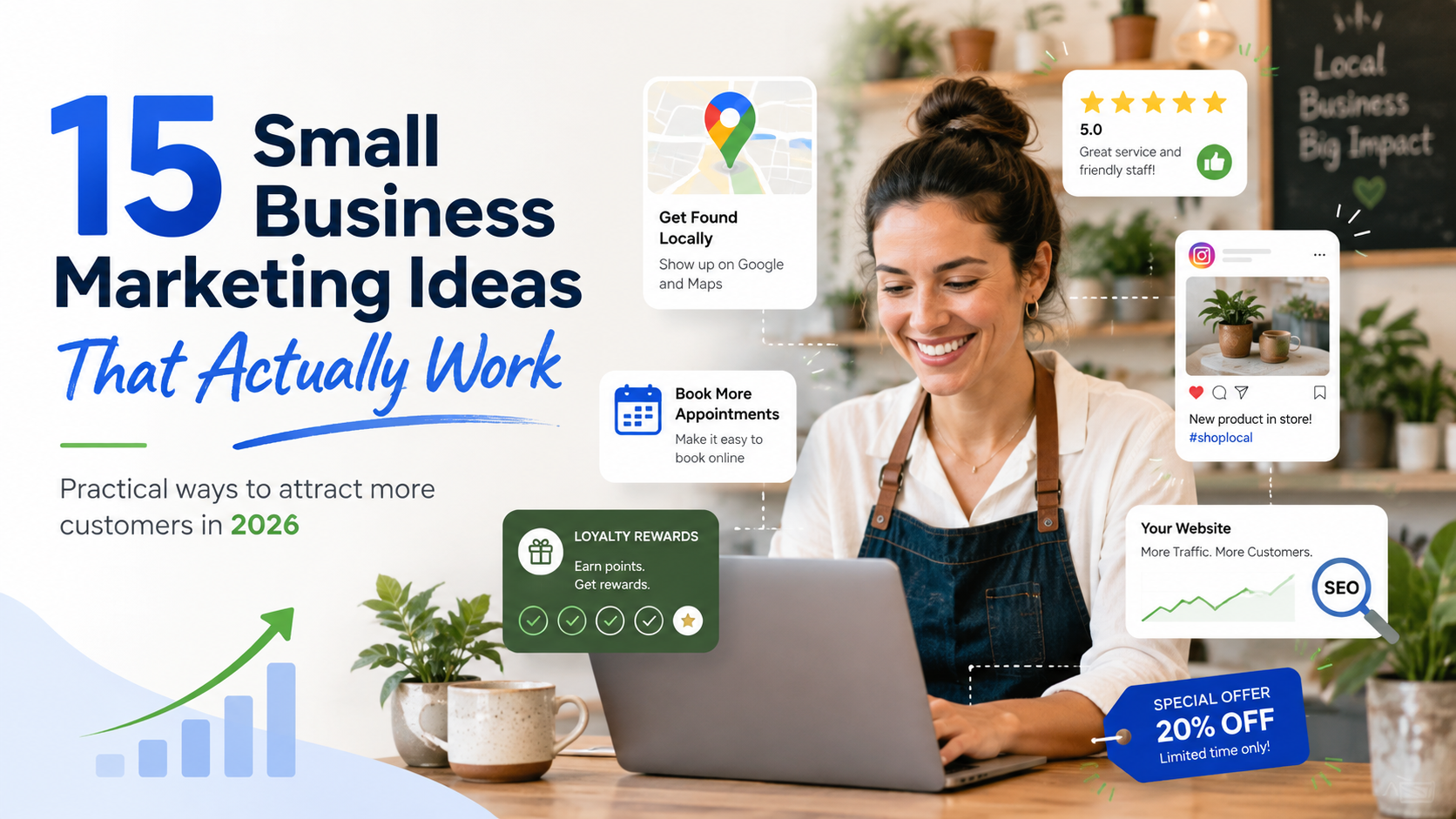
Small business marketing can feel overwhelming.
You’re told to post on Instagram, run ads, improve your SEO, send emails, make videos, ask for reviews, and somehow keep up with all of it while actually running your business.
The good news is that you don’t need to do everything.
The best small business marketing strategies are usually simple: help more people discover you, give them a reason to choose you, and stay connected so they come back.
Here are 15 marketing ideas that can actually help a small business grow.
1. Optimize Your Google Business Profile
For a local business, your Google Business Profile is one of the most important marketing assets you have.
It can appear when someone searches for things like:
- “coffee shop near me”
- “dentist in Fremont”
- “best auto repair near me”
- “hair salon open today”
Make sure your profile has accurate hours, services, categories, photos, contact information, and website links.
Don't set it up once and forget about it. Add new photos, publish updates, answer questions, and keep your information current.
The easier you make it for Google to understand your business, the easier it is for potential customers to find you.
2. Get More Google Reviews
Reviews are marketing.
A business with dozens of recent positive reviews often feels much safer to choose than a business with only a handful of old ones.
Make asking for reviews part of your normal customer experience.
You can send customers a review link after an appointment, add a QR code at checkout, or include a request in a follow-up message.
Don't try to pressure customers into leaving a five-star review. Simply make it easy for happy customers to share their experience.
And when someone leaves a review, respond.
Your response isn't only for that customer. Future customers will read it too.
3. Create Offers People Actually Care About
You don't always need a massive discount to attract attention.
Try offers such as:
- First-visit specials
- Buy one, get one promotions
- Free add-ons
- Seasonal packages
- Referral rewards
- Limited-time services
- Loyalty bonuses
The key is making the offer specific.
“10% off this weekend” is much easier to understand than a vague post telling people to “come visit us.”
Give customers a clear reason to take action now.
4. Make Your Website Answer Real Customer Questions
Your website shouldn't just say who you are.
It should answer the questions people ask before deciding whether to contact you.
For example, a dentist's website might answer:
- Do you offer Invisalign?
- How much does teeth whitening cost?
- Do you accept my insurance?
- Are you accepting new patients?
A salon might answer:
- Do you offer balayage?
- How much are haircuts?
- Do I need an appointment?
- How long does the service take?
Every useful answer gives Google another opportunity to show your business when someone searches for that information.
5. Create Pages for Every Important Service
One common SEO mistake is putting every service on a single page.
If you offer ten important services, consider creating dedicated pages for each one.
Instead of only having:
Services
you might have:
Permanent Makeup
Microblading
Lip Blush
Powder Brows
Each page can explain the service, pricing, frequently asked questions, photos, and how to book.
That gives each service a much better chance of appearing in Google searches.
6. Target Local Searches
If customers usually come from a specific city or service area, your marketing should reflect that.
Someone looking for a service usually doesn't search nationally.
They search:
“property management in Fremont”
rather than:
“property management.”
Use your city naturally across relevant pages, titles, descriptions, articles, and business listings.
If you serve multiple areas, you may also benefit from creating useful location pages for the cities you genuinely serve.
7. Post Helpful Content Instead of Constant Promotions
If every social media post says “BUY NOW,” people eventually tune you out.
Mix promotional posts with useful content.
A mechanic could post:
5 signs your brakes need to be checked.
A salon could post:
How often should you get a haircut?
A restaurant could feature:
How one of its most popular dishes is made.
A property manager could explain:
What landlords should check before choosing a tenant.
Helpful content builds trust before someone is ready to purchase.
8. Show Real People and Real Work
You don't need studio-quality content every day.
People often want proof that your business is real and active.
Post:
- Before-and-after photos
- Finished projects
- Customer stories
- Behind-the-scenes clips
- Team introductions
- New products
- Busy moments
- Frequently requested services
For many local businesses, an authentic phone photo of today's work can be more convincing than a generic stock photo.
9. Make Booking or Contacting You Extremely Easy
Marketing doesn't help much if customers get interested and then can't figure out what to do next.
Look at your website as if you were visiting it for the first time.
Can someone easily:
Call you?
Book an appointment?
Request a quote?
Get directions?
View your menu?
See your services?
Every extra step gives a potential customer another opportunity to leave.
Your call-to-action should be obvious.
10. Follow Up With Previous Customers
Businesses spend a lot of time trying to attract new customers while forgetting about people who already know them.
Your existing customers are often easier to bring back.
Depending on your business, you could send:
- Appointment reminders
- Seasonal offers
- New service announcements
- Birthday rewards
- Rebooking reminders
- Loyalty rewards
- “We haven't seen you in a while” offers
You don't need to message people constantly.
The goal is simply to stay visible enough that they remember you the next time they need what you sell.
11. Build a Simple Loyalty Program
If your business depends on repeat customers, reward repeat behavior.
A coffee shop might offer a free drink after a certain number of purchases.
A salon might offer rewards for repeat appointments.
A car wash could offer membership perks.
A restaurant could reward frequent visits.
Loyalty programs aren't only about giving things away.
They're about creating another reason for a customer to choose you instead of trying somewhere else.
12. Partner With Nearby Businesses
Some of your best potential customers may already be visiting another local business.
Look for businesses that serve a similar audience without directly competing with you.
For example:
A gym could partner with a healthy restaurant.
A wedding photographer could partner with a makeup artist.
A real estate agent could partner with a moving company.
A children's tutoring center could partner with an activity center.
You could cross-promote, create bundles, exchange referrals, or run a joint local event.
Local businesses don't always need to compete. Sometimes they can grow faster together.
13. Create Content Around What People Search
Blogging works best when you're answering something your customers are already searching for.
Instead of writing:
“Company Update: August”
write:
“How Much Does a Property Manager Cost in Fremont?”
Instead of:
“Our Dental Services”
write:
“How Much Does Invisalign Cost in Fremont?”
Search-focused articles can continue bringing people to your website long after you publish them.
A good rule is simple:
If customers regularly ask the question, somebody is probably searching for the answer too.
14. Track What's Actually Bringing Customers
Don't judge marketing only by likes.
Ask:
- Are more people calling?
- Are bookings increasing?
- Which Google searches are bringing visitors?
- Which pages generate inquiries?
- Which offers get redeemed?
- Are customers coming back?
- Where are new customers hearing about you?
You don't need complicated analytics.
You just need enough information to stop wasting money on things that aren't working and invest more in what is.
15. Be Consistent
This might be the least exciting strategy on the list, but it is one of the most important.
Many small businesses market intensely for two weeks, get busy, stop for three months, then start again when business slows down.
Marketing works better when it happens consistently.
Your Google profile stays updated.
New reviews keep coming in.
Your website continues growing.
Social media stays active.
Customers keep hearing from you.
You don't have to do everything every day.
You just need a system that keeps marketing moving even when you're busy running the business.
You Don't Need to Do Everything at Once
If you're reading these 15 ideas thinking, “I don't have time to do all of that,” that's completely reasonable.
Most small business owners didn't start their companies because they wanted to become full-time marketers.
Start with the fundamentals:
- Make sure people can find you on Google.
- Build strong reviews.
- Make your services easy to understand.
- Give customers an easy way to contact or book you.
- Stay visible consistently.
- Give existing customers reasons to come back.
Once those pieces are working, you can add more.
The businesses that win at local marketing aren't always the ones spending the most money.
They're often simply the businesses doing the right things consistently.
Let YupUp Handle the Marketing
YupUp helps small and local businesses stay on top of the marketing work that is easy to neglect when you're busy running a company.
From Google Business Profile management and local SEO to reviews, social media, offers, booking, loyalty, and ongoing marketing, YupUp helps keep your business visible and growing without requiring you to build an entire marketing team.
Run your business. Let YupUp help take care of the marketing.
Need a review and local marketing system?
YupUp helps independent businesses manage reviews, local visibility, and customer follow-up with AI-assisted workflows.
Get a free growth review