
Marketing for Restaurants: How to Fill Slow Days
Restaurant slow days don’t have to stay slow. Learn practical marketing strategies to increase weekday traffic, bring customers back, promote specials, and fill empty tables without relying on constant discounts.
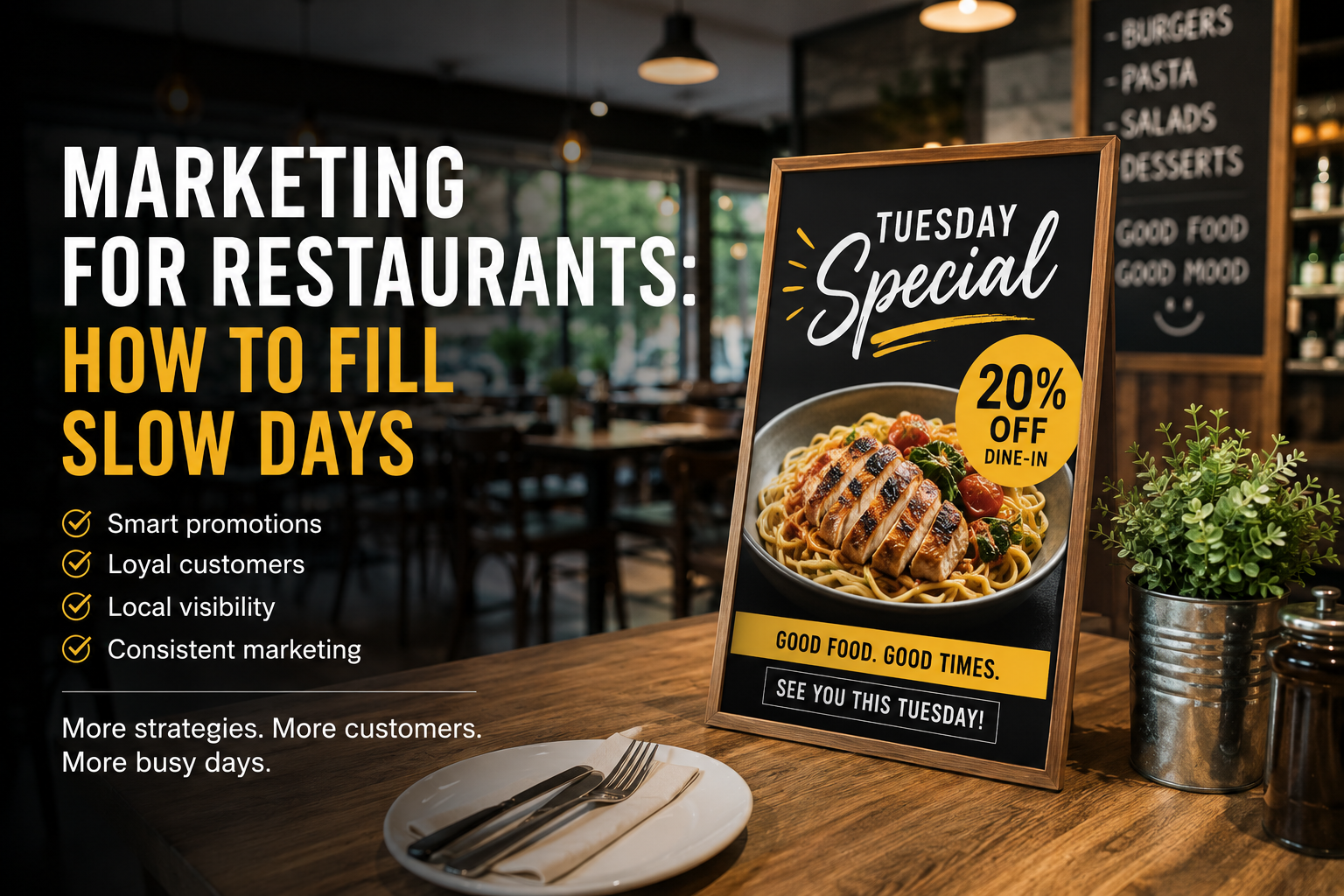
Every restaurant has them.
Maybe Monday lunch is dead.
Tuesday dinner never quite fills up.
Or business drops sharply between 2 PM and 5 PM while your staff, kitchen, and rent are still costing you money.
The instinct is often:
“Let's offer 20% off.”
That can work temporarily—but constantly discounting your food isn't the only way to bring customers through the door.
The better question is:
How can we give people a reason to visit specifically when we're slow?
Here are practical ways restaurants can turn quieter days and hours into more business.
1. Figure Out Exactly When You're Slow
Don't start with promotions.
Start with data.
Look at your sales by:
- Day of the week
- Hour
- Dine-in vs. takeout
- Average order value
- Menu category
- Repeat vs. new customers
You might discover that Tuesday isn't actually your problem.
Maybe Tuesday dinner is fine, but Tuesday from 2 PM to 5 PM is almost empty.
That's a much easier problem to market around.
Instead of:
20% off every Tuesday
you could offer something specifically from:
Tuesday, 2–5 PM.
That way you're not unnecessarily discounting customers who would have visited during dinner anyway.
2. Create a Slow-Time Offer, Not a Permanent Discount
Your promotion should give customers a reason to change when they visit.
For example:
Monday Date Night
Entrée + dessert bundle for two.
Tuesday Taco Special
Special menu available Tuesday evenings.
Wednesday Family Night
Family meal bundle for dine-in or takeout.
3–5 PM Happy Hour
Selected appetizers, drinks, or snacks.
Late-Night Special
Available after 9 PM.
Notice that these aren't necessarily blanket discounts.
You can bundle products, feature a particular menu item or add value instead.
That helps protect your pricing while still creating urgency.
3. Give Loyalty Members Extra Reasons to Come During Slow Hours
Your regular customers already like your restaurant.
Getting them to visit on Wednesday instead of Friday can be much easier than finding someone completely new.
Try offering loyalty members:
Double points on Tuesdays
Bonus points from 2–5 PM
Extra rewards for weekday visits
A free add-on after three weekday visits
Square, for example, specifically offers loyalty promotions designed around a restaurant's slower hours, allowing businesses to award additional points during selected days and times.
The important distinction is that you're rewarding behavior, not simply lowering every customer's bill.
4. Put the Promotion on Google, Not Just Instagram
Restaurants often create a great special...
…and then announce it once on Instagram.
Most potential customers will never see it.
Your Google Business Profile can also display offers, events and updates directly in Google Search and Maps. Google allows businesses to add dates, photos, coupon codes, links and calls to action to these posts.
If you run a Tuesday dinner special, someone searching:
“restaurants near me”
on Tuesday afternoon should have a chance to discover it.
Google also lets restaurants maintain menu information, photos, booking information and other restaurant-specific details directly on their Business Profile.
So whenever you launch a promotion, update more than one channel:
- Google Business Profile
- Your website
- Text/SMS
- Your local business listings
- In-store signage
Don't make customers hunt for your special.
5. Turn Slow Days Into an Event
Sometimes the offer doesn't need to be about price at all.
Give people something to do.
Examples:
Trivia Tuesday
Open Mic Wednesday
Live Music Thursday
Game Night
Kids Eat Free Night
Community Meetup
Sports Watch Party
Singles Night
Board Game Evening
An event changes the customer's question from:
“Where should we eat?”
to:
“Where should we go tonight?”
That's a much stronger reason to pick your restaurant over another option.
6. Create Specials Around What You Already Sell Well
Don't create a completely different business just to fill Tuesday night.
Look at what customers already love.
If your restaurant is known for biryani, Tuesday could become:
Biryani Tuesday
If customers love your wings:
Wing Wednesday
If you're known for margaritas:
Taco & Margarita Tuesday
If dessert performs well:
Dessert Date Night
This makes your promotion easier to understand and reinforces the food you already want your restaurant to be known for.
7. Build Bundles Instead of Cutting Prices
Customers often respond to perceived value just as much as discounts.
Instead of:
20% off your entire order
try:
Lunch Combo — entrée + drink
Family Dinner for Four
Date Night for Two
Appetizer + Entrée + Dessert
Game-Day Meal Bundle
Bundles can make choosing easier for the customer while allowing the restaurant to control which items are included.
They can also help you promote menu items with strong margins.
8. Bring Back Customers Who Haven't Visited Recently
Your best slow-day customer might already be in your database.
Someone who visited three months ago doesn't necessarily dislike your restaurant.
They may simply have forgotten about you.
Send an email or text such as:
“We haven't seen you in a while. Here's what's happening this Wednesday.”
Then give them a specific reason to return.
Restaurants can use loyalty and customer-history tools to identify returning customers and send targeted offers rather than marketing every promotion to everyone.
This is usually more useful than sending the same generic:
“Come visit us!”
message every week.
9. Partner With Nearby Businesses
Look at who is already bringing people into your neighborhood during your slow period.
Potential partners might include:
- Gyms
- Salons
- Offices
- Schools
- Apartment communities
- Hotels
- Entertainment venues
- Sports facilities
- Coworking spaces
- Local clubs
For example:
A gym could share your healthy lunch special.
A nearby office could receive a weekday catering offer.
A hotel could recommend your restaurant to guests.
A movie theater could partner on a dinner-and-movie promotion.
Local marketing works especially well when both businesses serve similar customers without directly competing.
10. Create Different Offers for Different Customers
Not every promotion needs to target everyone.
If weekday lunch is slow, target:
office workers
with lunch combos or ordering incentives.
If afternoons are slow, target:
students and remote workers
with coffee, snacks, Wi-Fi or study-friendly specials.
If early dinner is slow, target:
families
with family meals.
If late evenings are slow, target:
younger adults, groups or post-event diners.
The more specific your offer is, the easier it becomes to market.
“Come eat at our restaurant Tuesday” isn't very compelling.
“$15 Tuesday lunch combo for nearby office workers, available 11 AM–2 PM” gives someone an actual reason to act.
11. Ask Happy Customers for Reviews
Slow-day marketing isn't only about promotions.
Your restaurant also needs to win when someone is deciding where to eat.
If a customer searches:
“best Thai restaurant near me”
and sees two restaurants—
one with strong recent reviews and good food photos,
and another with an outdated profile and very few reviews—
the decision may already be made.
Encourage satisfied customers to leave honest reviews and respond to the reviews you receive.
Google specifically recommends restaurants use their Business Profile to respond to reviews and monitor how customers discover and interact with the business.
Better visibility helps every day—not just Tuesday.
12. Make Slow-Day Promotions Easy to Find
One of the biggest mistakes restaurants make is running promotions nobody knows about.
If you have a Wednesday special, customers should be able to find it when searching:
restaurant deals near me
Wednesday restaurant specials
happy hour near me
family dinner deals
lunch specials near me
Put the information somewhere searchable.
Don't let an Instagram Story that disappears after 24 hours be the only evidence that your promotion exists.
13. Measure Whether the Promotion Actually Worked
After a few weeks, look at the numbers.
Ask:
- Did traffic increase?
- Did revenue increase?
- What was the average ticket?
- Were customers new or returning?
- Did they buy anything beyond the promotional item?
- Did they return later without the promotion?
- How much did the promotion actually cost?
A promotion that brings 100 customers but loses money isn't automatically successful.
And a promotion that attracts 20 new customers who later become regulars could be extremely valuable.
Your goal isn't just to make Tuesday busy.
Your goal is to make the restaurant more profitable over time.
Slow Days Are a Marketing Opportunity
A slow Tuesday isn't necessarily evidence that people don't want your food.
Sometimes customers simply don't have a reason to choose Tuesday.
Give them one.
Create a specific offer.
Reward repeat customers.
Promote it where people are already searching.
Build events and partnerships.
Keep your Google presence current.
Then measure what actually brings customers through the door.
The difficult part is doing all of that consistently while you're also dealing with inventory, employees, suppliers, food quality, scheduling, customer service and everything else involved in running a restaurant.
That's where YupUp can help.
YupUp helps local businesses manage marketing across areas such as local visibility, promotions, reviews, websites, customer engagement and ongoing marketing—so business owners don't have to become full-time marketers themselves.
Your slow days don't necessarily need bigger discounts. They need better marketing.
Get a free YupUp Growth Review to identify where your restaurant may be losing local customers and what opportunities could help bring more people through the door.
Need a review and local marketing system?
YupUp helps independent businesses manage reviews, local visibility, and customer follow-up with AI-assisted workflows.
Get a free growth review