
Getting New Customers vs. Keeping Existing Customers: Where Should Small Businesses Spend Their Money?
Should your small business spend more on attracting new customers or retaining existing ones? Learn where your marketing budget can have the biggest impact.
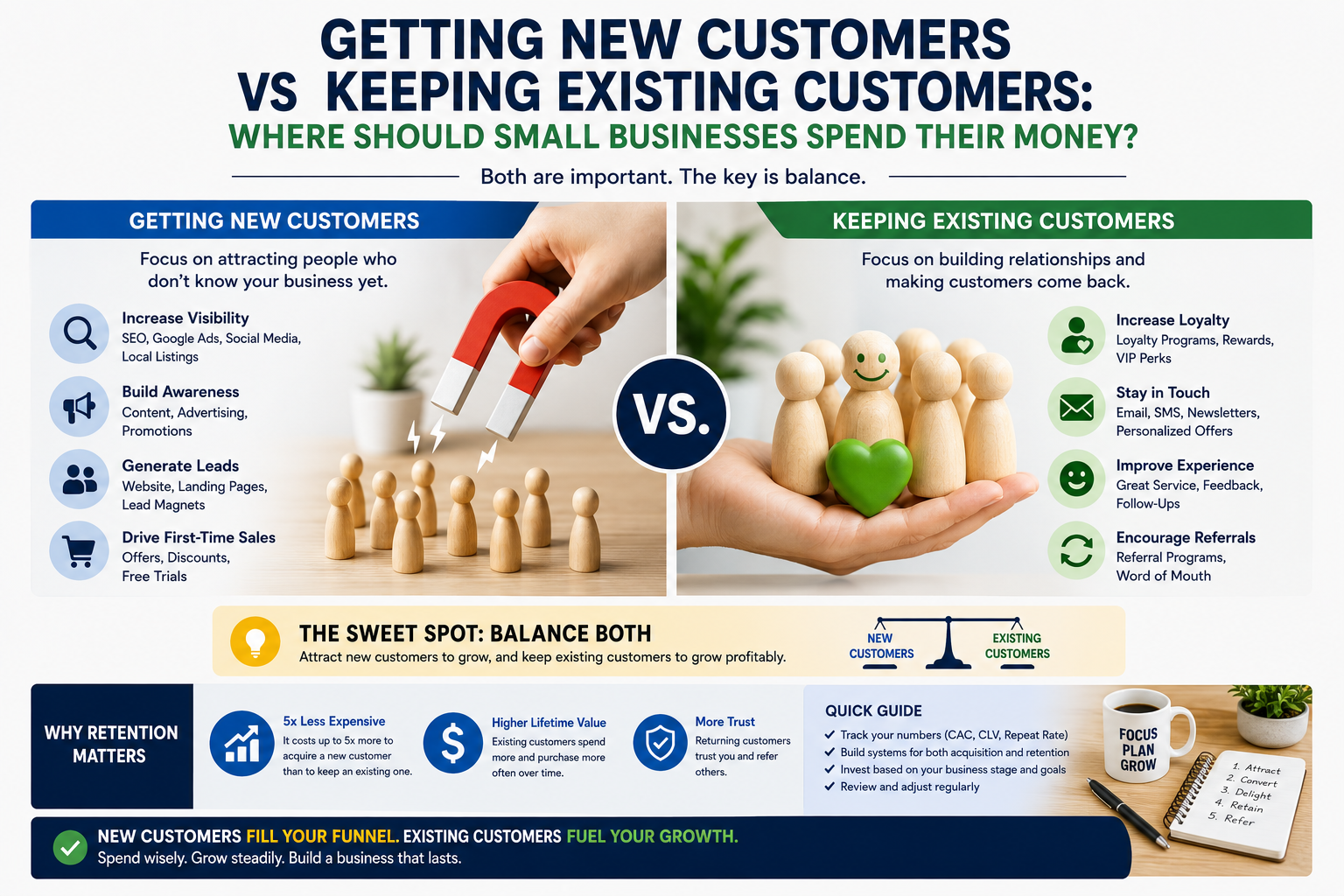
Every small business wants more customers.
So when it's time to spend money on marketing, the obvious thought is:
How do I get more new customers?
Run ads.
Improve Google rankings.
Post on social media.
Create promotions.
Get more people through the door.
All of those can work.
But there's another question small businesses don't ask nearly enough:
What are we doing with the customers we already have?
Because getting someone to choose your business for the first time is only half the opportunity.
If they never come back, you have to pay to replace them.
Again.
And again.
And again.
In 2026, that can get expensive. Recent HubSpot research notes that customer acquisition costs have risen substantially in recent years, making retention increasingly important for smaller businesses.
So where should your marketing money actually go?
The answer isn't new customers OR existing customers.
It's understanding when each deserves more of your budget.
First, Understand the Difference
Customer Acquisition
Customer acquisition is everything you do to attract someone who hasn't bought from you before.
That could include:
- Google Ads
- Facebook and Instagram ads
- Local SEO
- Google Business Profile optimization
- Promotions
- Social media
- Events
- Direct mail
- Referral campaigns
- Content marketing
The goal is:
Turn strangers into customers.
Customer Retention
Retention marketing focuses on people who have already purchased from you.
That can include:
- Loyalty programs
- Rebooking reminders
- Email marketing
- Text campaigns
- Birthday offers
- Customer appreciation promotions
- Membership programs
- Referral rewards
- Personalized offers
- Great customer service
The goal is:
Give customers a reason to come back.
You need both.
But depending on your business, putting another $1,000 into customer acquisition may not always be the smartest next move.
Why Existing Customers Can Be So Valuable
Imagine you run a salon.
You spend:
$50 to acquire a new customer.
They book a $120 appointment.
At first glance, that sounds great.
But what happens next?
Customer A
Visits once.
Revenue:
$120
Customer B
Comes back every eight weeks.
Six visits in a year:
$720
Same initial acquisition.
Very different value.
That's why businesses should think beyond:
“How many new customers did we get?”
and start asking:
“How much is each customer worth over the entire relationship?”
That's customer lifetime value.
Stripe notes that long-term customers can contribute more predictable revenue and often buy more frequently or become more receptive to additional products and services.
Retention Makes Your Acquisition Spending More Valuable
This is the part that gets overlooked.
Retention isn't competing with acquisition.
Retention makes acquisition work better.
Suppose you spend $2,000 on marketing and acquire 40 customers.
If almost all of them disappear after one purchase, you need another $2,000 campaign to replace them.
But if 25 of those customers keep returning, your original advertising continues producing revenue long after the campaign ended.
Now your next $2,000 isn't replacing everyone you lost.
It's adding customers on top of a stronger existing base.
That's how growth starts compounding.
So Should You Stop Spending Money on New Customers?
Absolutely not.
A business cannot retain customers it never acquired.
If you're new, your first priority has to be getting people through the door.
And even established companies need a steady flow of new customers because:
- Customers move
- Needs change
- People switch providers
- Some customers naturally stop buying
- Your business may want to expand
- Your competitors are trying to acquire customers too
HubSpot's guidance on acquisition versus retention reaches essentially the same conclusion: businesses need both, and the right emphasis depends on their growth goals and existing customer base.
The real goal is to stop treating acquisition as the only form of marketing.
When You Should Spend More on Getting New Customers
You probably need to lean more heavily toward acquisition when:
1. Your Business Is New
If you opened three months ago and have 40 customers, you simply don't have a large enough existing customer base to rely on retention.
You need visibility.
Focus on:
Google Business Profile
Local SEO
Advertising
Introductory offers
Community awareness
Reviews
Your first job is getting enough people to discover and try you.
2. You Have Empty Capacity
Suppose your salon could handle 40 appointments a day but you're averaging 18.
Or your restaurant has empty tables every weekday.
Or your contractor has room for another five jobs per month.
You have capacity that isn't generating revenue.
Acquisition marketing can help fill it.
3. You're Entering a New Market
Opening another location?
Introducing a completely new service?
Expanding into a neighboring city?
You need awareness.
Existing customers may help, but acquisition becomes more important because you're trying to reach people who don't know you yet.
4. Customers Naturally Buy From You Infrequently
Some businesses have fewer opportunities for repeat purchases.
Think:
Roofing companies
Wedding photographers
Real estate agents
Someone isn't buying another roof next Tuesday.
For these businesses, acquisition and referrals may deserve a larger percentage of marketing attention.
Retention still matters — but it may look more like:
referrals
reviews
recommendations
rather than frequent repeat purchases.
When You Should Spend More on Existing Customers
Retention deserves significantly more attention when your business naturally depends on repeat purchases.
Think:
Restaurants
Coffee shops
Salons
Barbers
Spas
Gyms
Dental offices
Auto maintenance
Pet grooming
Cleaning services
Subscription businesses
If customers should logically return but aren't, spending more money finding strangers may be treating the symptom instead of the problem.
Ask Yourself This Question
If every new customer I acquired this month disappeared afterward, would my business still grow?
Probably not.
That means retention needs to become part of your marketing strategy.
Signs You're Spending Too Much on Acquisition
Here's a common situation.
A business says:
“We need more customers.”
So it spends $3,000 on advertising.
Customers arrive.
But the business has:
No loyalty program.
No email list.
No follow-up.
No rebooking reminder.
No customer database.
No referral system.
No win-back campaign.
Three months later:
“We need more customers.”
Another $3,000 gets spent.
That's a leaky bucket.
Instead of constantly pouring more water into it, fix the holes.
Where Should a Small Business Spend Its Marketing Budget?
There isn't one perfect percentage for every company.
But here's a useful way to think about it.
If You're Brand New
Your budget may need to lean heavily toward acquisition.
For example:
70–80% acquiring customers
20–30% retention infrastructure
That doesn't mean ignoring retention.
Even when you're new, start collecting:
- Customer contact information
- Reviews
- Email subscribers
- Loyalty members
Build the system early.
If You're an Established Repeat-Purchase Business
The balance can become much closer.
Something like:
50–60% acquisition
40–50% retention
may be a reasonable starting point to test.
The exact number isn't important.
The point is that retention should become a real marketing budget category, not an afterthought.
If Customer Churn Is High
If you're constantly bringing customers in and losing them, consider temporarily spending more effort on retention.
Don't increase advertising just because revenue is dropping.
First ask:
Why aren't customers returning?
More marketing cannot permanently fix a poor customer experience.
If You're Expanding Aggressively
If you've already built strong retention and want to grow faster, you can shift more money toward acquisition.
That's where advertising becomes particularly powerful:
You're pouring new customers into a system that already knows how to keep them.
Where Should You Spend Your Customer Acquisition Money?
If you need new customers, prioritize channels where buying intent already exists.
For local businesses, that often means:
Google Business Profile
People searching for your category near them already have a problem they want solved.
Local SEO
Rank for searches such as:
“dentist in Fremont”
“property management company near me”
“best barber in Fremont”
Search Advertising
Reach people actively looking for what you sell.
Referral Programs
Your happiest customers can become an acquisition channel.
Strong Offers
Give first-time customers a clear reason to try you.
The goal shouldn't simply be:
More traffic.
It should be:
More qualified potential customers.
Where Should You Spend Your Retention Money?
Retention doesn't have to be expensive.
Start with systems that make returning easy.
1. Rebooking Reminders
For appointment businesses, don't simply say goodbye after an appointment.
Make the next appointment easy.
2. Loyalty Programs
Reward customers for behaviors you want to encourage:
- Repeat visits
- Purchases
- Referrals
3. Email and Text Marketing
Stay in touch when you actually have something useful to say.
Announce:
new services
special offers
seasonal products
events
reminders
4. Win-Back Campaigns
Look at customers who haven't visited recently.
Give them a reason to return.
A simple:
“We haven't seen you in a while.”
campaign can be far easier than convincing someone completely unfamiliar with your business to try you.
5. Great Customer Service
Marketing cannot save a bad experience indefinitely.
Retention begins with delivering something customers genuinely want to experience again.
Don't Forget Referrals
Here's where acquisition and retention start overlapping.
A loyal customer isn't only valuable because they keep buying.
They can also bring you another customer.
A happy customer might:
Return
then
Leave a review
then
Recommend you to a friend
then
Bring that friend with them
Now retention has become acquisition.
That's why your best customers can become one of your strongest marketing channels.
The Three Numbers Every Small Business Should Know
You don't need a giant analytics team.
Start with three numbers.
Customer Acquisition Cost
How much are you spending to acquire one new customer?
If you spend $1,000 and get 20 new customers:
CAC = $50
Customer Lifetime Value
Approximately how much revenue or profit does an average customer generate during their relationship with you?
Repeat Customer Rate
How many customers actually purchase from you again?
Once you know those three numbers, marketing decisions become much easier.
Instead of:
“Instagram seems like it's working.”
you can start asking:
“Which channel brings customers who actually stay?”
That's a much more valuable question.
One-Time Customers Aren't Always Bad
There are legitimate reasons customers don't return.
A tourist visiting your restaurant isn't necessarily going to fly back every month.
Someone getting emergency car repair while traveling might never need you again.
A wedding client ideally isn't booking another wedding photographer next year.
So don't blindly chase retention.
Think about how customers should naturally behave in your industry.
The goal isn't 100% retention.
It's making sure good customers aren't disappearing simply because you forgot about them.
The Best Strategy: Acquire, Retain, Refer
Instead of thinking about your marketing funnel as:
Find customer → Make sale → Finished
think:
1. Acquire
Help someone discover the business.
↓
2. Convert
Make it easy for them to choose you.
↓
3. Deliver
Give them a great experience.
↓
4. Retain
Give them a reason to return.
↓
5. Refer
Make it easy for happy customers to recommend you.
↓
6. Acquire
Those referrals create new customers.
Now you have a cycle instead of a funnel.
That's much healthier for a small business.
So, New Customers or Existing Customers?
Both.
But stop automatically giving new customer acquisition 100% of your attention.
If you're new or have lots of unused capacity, acquisition probably deserves the larger investment.
If you already have hundreds or thousands of customers but very few return, retention may be your biggest growth opportunity.
And if you've built strong retention?
That's when spending more on acquisition gets really interesting.
Because every new customer you're paying to acquire has the potential to become:
a repeat customer
a loyal customer
a reviewer
a referral source
and
a much more valuable customer over time.
The smartest small businesses don't choose between getting customers and keeping customers.
They build a system that does both.
YupUp Helps You Work on Both Sides of Growth
Getting discovered matters.
So does giving customers a reason to return.
Orbit by YupUp helps small and local businesses keep both sides of marketing moving — from Google Business Profile management, local SEO, reviews, content, and social media to offers, booking, loyalty, and customer retention.
Because sustainable growth isn't just:
Get more customers.
It's:
Get them. Keep them. Give them a reason to tell someone else.
Need a review and local marketing system?
YupUp helps independent businesses manage reviews, local visibility, and customer follow-up with AI-assisted workflows.
Get a free growth review