
Can You Grow a Business Without a Full-Time Marketer?
Yes, small businesses can grow without hiring a full-time marketer. Learn what marketing you actually need, what to outsource, what to automate, and when hiring makes sense.
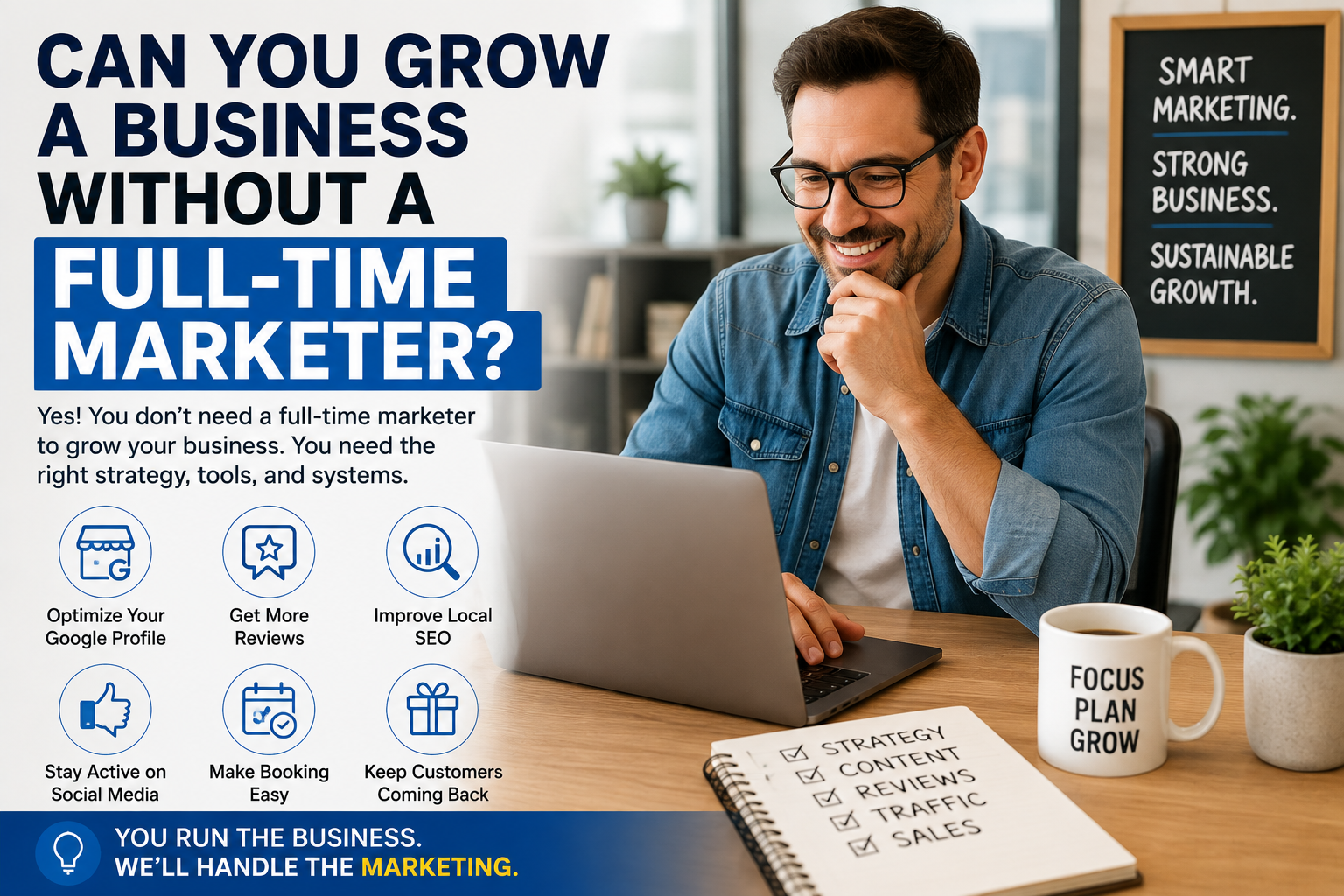
Yes.
You can absolutely grow a business without hiring a full-time marketer.
In fact, for many small businesses, hiring a full-time marketing employee too early may not be the best use of money.
The real question isn't:
“Do I need a marketer?”
It's:
“How do I make sure marketing actually gets done?”
Because your business still needs customers to discover you, trust you, choose you, and come back.
Someone has to take care of your Google presence.
Someone has to respond to reviews.
Someone has to keep your website updated.
Someone has to create offers.
Someone has to keep social media active.
Someone has to figure out why customers aren't finding you.
But that doesn't necessarily mean you need another full-time employee.
What Does a Full-Time Marketer Actually Cost?
When a small business considers hiring a marketer, it's easy to think only about salary.
But an employee comes with more than salary.
Depending on your situation, you may also have:
- Payroll taxes
- Benefits
- Recruiting costs
- Software
- Training
- Equipment
- Management time
- Paid time off
Then there's another problem.
One person probably won't be great at everything.
SEO requires one skill set.
Social media requires another.
Advertising is different again.
Graphic design, website management, email marketing, analytics, copywriting, and reputation management all require different skills.
So hiring one marketer doesn't automatically mean you've built an entire marketing department.
For a growing small business, that distinction matters.
What Marketing Does a Small Business Actually Need?
Most local businesses don't need a giant marketing department.
They need a few important systems working consistently.
At a minimum, customers should be able to:
Find you.
Understand what you offer.
Trust you.
Contact or book you easily.
Remember you later.
That generally means focusing on a few core areas.
1. Google Business Profile
If you serve local customers, your Google Business Profile can be one of your most important marketing channels.
Google says businesses with complete and accurate Business Profile information are more likely to appear in relevant local search results. Local ranking is mainly influenced by relevance, distance, and prominence.
Your profile should stay current with:
- Business hours
- Address or service area
- Phone number
- Categories
- Services
- Photos
- Reviews
- Business updates
That's ongoing marketing work.
But it doesn't require someone sitting at a desk for 40 hours a week.
2. Local SEO
Your website should help Google understand what you do and where you do it.
If you're a dentist in Fremont, you don't just want people searching your business name.
You want to appear when someone searches:
dentist in Fremont
Invisalign Fremont
emergency dentist near me
teeth whitening Fremont
The same idea applies to salons, restaurants, property managers, auto shops, contractors, gyms, and almost every other local business.
Good local SEO means creating useful pages around your actual services and answering questions customers are already searching.
Again, this requires consistent work.
But it doesn't necessarily require a full-time employee.
3. Reviews and Reputation
Potential customers often check reviews before making a decision.
Your business should have a simple system for:
- Asking customers for reviews
- Monitoring new reviews
- Responding to reviews
- Handling negative feedback professionally
Google itself encourages businesses to respond to reviews and notes that reviews can help businesses stand out in local search.
The mistake many businesses make is waiting until reviews become a problem.
Reputation management should happen continuously.
4. Social Media
You probably don't need to post twelve times a day.
You do need to look alive.
If someone finds your business on Google and then checks Instagram, what do they see?
A profile that hasn't been updated since 2023?
Or recent photos, customer experiences, helpful tips, offers, and signs that the business is active?
Social media can help reinforce trust.
For many local businesses, that's more valuable than trying to become an influencer.
5. Customer Retention
Marketing shouldn't stop after someone becomes a customer.
Your existing customers already know you.
Give them reasons to return.
That can include:
- Rebooking reminders
- Loyalty rewards
- Special offers
- Birthday promotions
- Seasonal campaigns
- New service announcements
- Referral incentives
Sometimes growing your business isn't about finding 500 completely new customers.
It's getting more of your existing customers to come back.
So Who Does the Marketing?
If you're not hiring a full-time marketer, there are several options.
Option 1: The Owner Does Everything
This is how many businesses start.
And initially, it can work.
You know the business better than anyone.
You know your customers.
You understand the brand.
The problem is time.
Marketing usually gets pushed down the priority list when:
- Customers need attention
- Employees call out
- Inventory needs ordering
- Payroll is due
- Something breaks
- Business suddenly gets busy
Then marketing stops.
A few months later, business slows down and everyone suddenly remembers marketing again.
That cycle is extremely common.
Doing your own marketing can work.
But only if you actually have enough time to do it consistently.
Option 2: Hire Freelancers
You can hire specialists for specific tasks.
For example:
SEO freelancer
Social media manager
Graphic designer
Google Ads specialist
Website developer
This can give you access to specialized skills without hiring full-time employees.
The downside is coordination.
If you're working with five freelancers, congratulations:
You may have accidentally become the marketing manager.
Someone still has to tell everyone what to do, approve work, track results, share passwords, review invoices, and make sure the strategy fits together.
Option 3: Hire a Marketing Agency
An agency can take on much more of the work.
That may include:
- Strategy
- SEO
- Paid advertising
- Social media
- Content
- Website work
- Email campaigns
This can be a good option for businesses that need significant marketing support.
But traditional agency retainers can be difficult for smaller businesses to justify, especially when they don't need every service offered.
The important thing is understanding exactly what you're paying for.
Don't hire an agency simply because you feel like you're “supposed to be doing marketing.”
Know what outcomes you're trying to achieve.
Option 4: Use Marketing Automation and AI
This is becoming increasingly practical for small businesses.
AI and automation can now help with tasks such as:
- Drafting social media posts
- Writing review responses
- Suggesting promotions
- Creating content ideas
- Preparing email campaigns
- Monitoring marketing activity
- Analyzing performance
- Reusing content across channels
But there's an important warning.
AI doesn't magically create a marketing strategy.
Giving a business owner another AI tool and saying:
“Here you go. Do your marketing.”
doesn't solve the original problem.
The business owner still has another thing to manage.
The real value comes when automation reduces the amount of marketing work the owner personally has to remember and execute.
Option 5: Use a Done-for-You Marketing System
For many small businesses, this is the middle ground.
Instead of:
doing everything yourself
or
hiring an entire marketing department,
you use an outside system or service to keep the important work moving.
The business owner still provides direction.
You still decide:
- Your services
- Your offers
- Your brand
- Your priorities
- What makes your business different
But you don't personally have to remember every post, review, profile update, SEO task, or campaign.
That's often what small business owners actually want.
Not another dashboard.
Not another tool.
Not another employee to manage.
They want the marketing handled.
When Should You Hire a Full-Time Marketer?
There absolutely comes a point where hiring internally can make sense.
Consider a full-time marketing hire when:
Marketing has become a major part of your operation
If you're running campaigns constantly across several channels, someone may genuinely have enough work for a full-time role.
Your business has enough revenue to comfortably support the position
Don't hire a marketing employee simply because growth feels slow.
Understand whether the business can support the salary and associated costs long term.
You need deep internal knowledge
Some businesses need someone embedded in the organization every day.
That can be especially valuable when marketing requires constant coordination with sales, product teams, locations, or leadership.
You're ready to build a marketing department
Your first marketing employee may eventually manage agencies, freelancers, advertising budgets, content teams, and strategy.
At that point, the internal role starts making much more sense.
When You Probably DON'T Need One Yet
You may not need a full-time marketer if:
- You're a small local business
- You have one or a few locations
- Your marketing needs are relatively straightforward
- You mainly need Google, SEO, reviews, social media, offers, and customer retention handled
- You can't justify a full-time salary
- You don't have enough work for someone 40 hours a week
- You already spend too much time managing employees
- You want marketing done without building another department
That's a large percentage of small businesses.
The Real Problem Is Usually Consistency
Here's what often happens.
January:
“This year we're going to take marketing seriously.”
The Google profile gets updated.
Three Instagram posts go out.
Someone starts writing a blog.
The business asks five customers for reviews.
Then February gets busy.
And everything stops.
By June:
The latest social post is four months old.
Reviews aren't being answered.
The website hasn't changed.
Nobody knows whether SEO is working.
There hasn't been a promotion in months.
This is why consistency matters more than having the fanciest marketing strategy.
A simple system running every week can outperform a brilliant marketing plan that gets ignored.
What Should You Do Instead?
If you don't want to hire a full-time marketer yet, make sure someone or something owns each important marketing function.
A simple system could look like:
Google Business Profile: Keep information accurate and active.
Local SEO: Build useful service and location pages.
Reviews: Ask consistently and respond quickly.
Social Media: Stay active and show what the business is doing.
Offers: Give customers reasons to act.
Booking: Make it easy to become a customer.
Loyalty: Give existing customers reasons to return.
Analytics: Understand what's actually working.
You don't need twenty marketing channels.
You need the important ones running reliably.
Can You Grow Without a Full-Time Marketer?
Absolutely.
You cannot grow indefinitely without marketing.
But marketing and hiring a full-time marketer are not the same thing.
A small business can use a combination of:
automation
AI
freelancers
outside services
specialists
and
done-for-you marketing
to get the work done without immediately building an internal marketing department.
The right choice depends on your size, budget, goals, and how complicated your marketing has become.
The key question is simple:
Is your marketing getting done consistently without taking your attention away from running the business?
If the answer is yes, you may not need a full-time marketer at all.
If the answer is no, the solution isn't necessarily another employee.
It may simply be a better system.
Marketing Without Building a Marketing Department
That's exactly the problem YupUp is designed to solve.
Orbit by YupUp helps small and local businesses keep important marketing work moving — from Google Business Profile management and local SEO to reviews, social media, offers, booking, loyalty, and ongoing marketing.
Instead of adding another full-time person to manage, you can keep your focus where it belongs:
running your business.
You run the business. Orbit helps run the marketing.
Need a review and local marketing system?
YupUp helps independent businesses manage reviews, local visibility, and customer follow-up with AI-assisted workflows.
Get a free growth review