
Best Marketing Strategies for Small Businesses in 2026
Discover the best small business marketing strategies for 2026, from local SEO and Google reviews to social media, AI, loyalty programs, and customer retention.
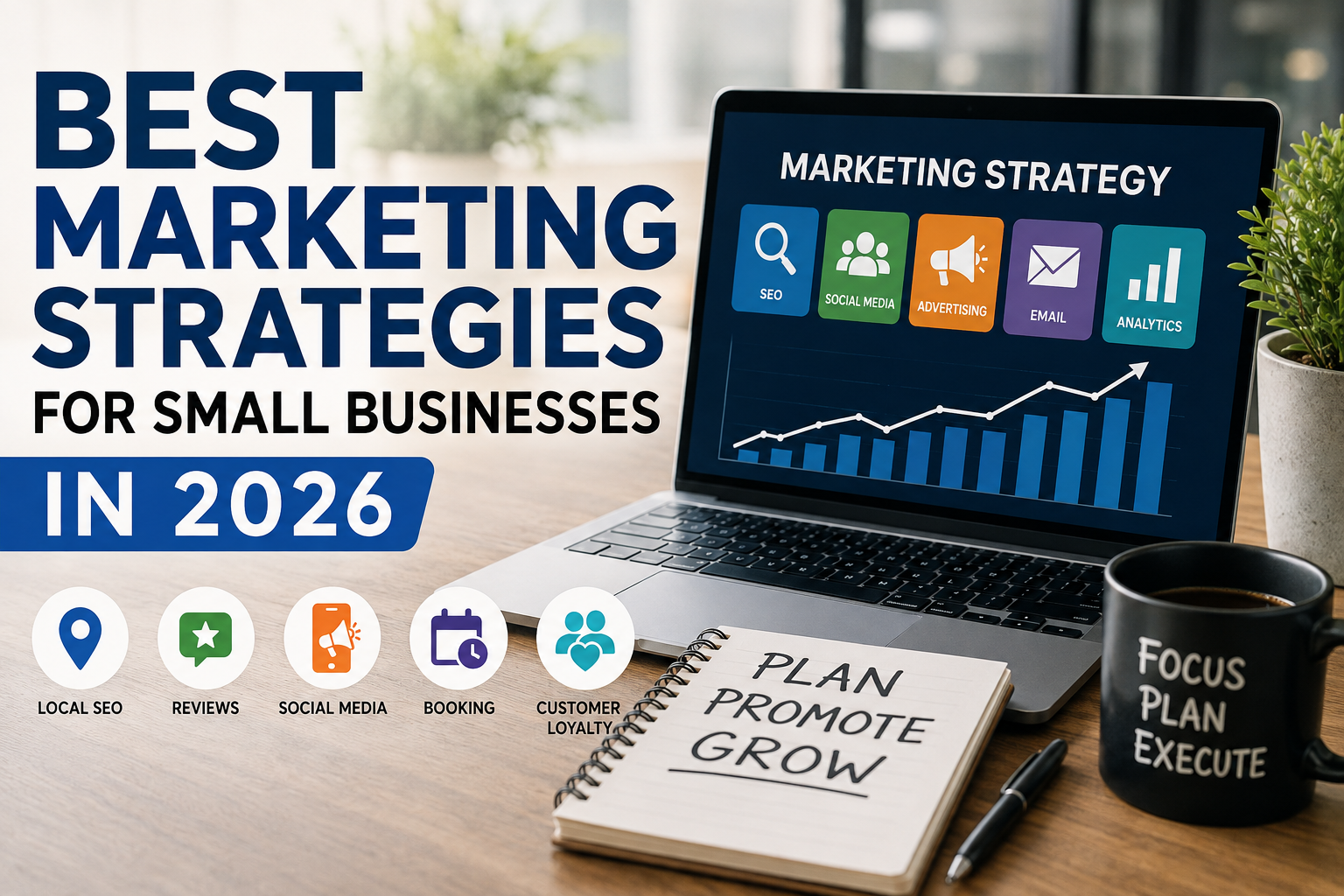
Marketing a small business in 2026 doesn't mean being everywhere.
It means being in the right places when potential customers are looking for you — and making it incredibly easy for them to choose you.
Google is still a major part of that journey. Recent consumer research found that 84% of consumers had searched online for a local business within the previous three months, although customers increasingly use multiple platforms before making a decision.
That means the best small business marketing strategy isn't relying on one channel.
It's building a connected system where Google, your website, reviews, social media, offers, booking, and customer retention all support each other.
Here are the strategies small businesses should focus on in 2026.
1. Make Google Your First Priority
For most local businesses, Google should be one of the first places you invest your marketing effort.
Think about how people search when they need something:
“dentist near me”
“best coffee shop in Fremont”
“oil change near me”
“property manager in Fremont”
“Indian restaurant open now”
Google Business Profiles can appear directly in Google Search and Maps and show customers information such as your hours, location, website, photos, services and reviews.
Make sure your profile includes:
- Correct business information
- Accurate hours
- The right business categories
- Services and products
- Current photos
- Website and booking links
- Customer reviews
- Regular updates
Google specifically recommends keeping business information complete and up to date to improve visibility in local search results.
For a local business, your Google presence should never be an afterthought.
2. Invest in Local SEO
Google Business Profile is only one part of being found.
Your website also needs to clearly tell search engines:
What do you do?
Where do you do it?
Who do you serve?
Instead of trying to rank for something extremely broad like:
“dentist”
a local dental office would have a much better opportunity targeting:
“dentist in Fremont”
or specific searches like:
“Invisalign in Fremont”
The same strategy applies to almost every local business.
Build individual pages around your important services and locations.
A beauty studio, for example, could have separate pages for:
- Permanent Makeup
- Microblading
- Lip Blush
- Powder Brows
Those pages give Google more context and give customers a much better answer to what they're actually searching for.
3. Turn Customer Reviews Into a Marketing Channel
Reviews aren't just reputation management anymore.
They're part of the buying process.
Imagine seeing two businesses.
One has:
4.8 stars with 280 reviews
and another has:
4.2 stars with 17 reviews.
Even before visiting their websites, many customers have already formed an opinion.
Create a simple process for consistently asking satisfied customers for reviews.
You could use:
- QR codes
- Follow-up texts
- Emails
- Receipts
- Booking confirmations
- Post-service messages
Then respond to your reviews.
Google Business Profile itself allows businesses to collect and respond to customer reviews directly through their profile.
Don't wait until you desperately need reviews.
Make review generation part of the normal customer experience.
4. Create Content Based on What Customers Search For
Content marketing still works.
But writing random blog posts doesn't.
The most useful content answers questions potential customers are already typing into Google.
A property management company might write:
How Much Does Property Management Cost in Fremont?
A dentist might write:
How Much Does Invisalign Cost in Fremont?
A salon could write:
Balayage vs Highlights: Which One Should You Choose?
An auto repair shop could write:
How Often Should You Change Your Oil?
These articles attract people while they're researching a problem.
Then your business becomes one of the companies they discover while looking for the answer.
Think of your customers' questions as your SEO content calendar.
5. Use Social Media to Build Trust, Not Just Followers
Small businesses often make one of two mistakes on social media.
They either don't post at all...
or every post is:
BUY THIS. BOOK NOW. SALE TODAY.
Social media works better when customers get to know the business.
Show:
- Your team
- Your work
- Before-and-after results
- New products
- Customer stories
- Behind-the-scenes moments
- Helpful advice
- Frequently asked questions
- Special offers
- Community involvement
Someone might discover your business on Google and then check Instagram before deciding whether to book.
That's why your marketing channels shouldn't operate separately.
Your social presence reinforces the trust you created somewhere else.
6. Make Booking as Easy as Possible
Every extra step between:
“I'm interested”
and
“I'm booked”
can cost you a customer.
If someone discovers your business at 10:30 PM, they probably don't want to remember to call tomorrow morning.
Let them take action immediately when possible.
Depending on your business, that might mean:
Book Appointment
Request Quote
Reserve Table
Order Online
Call Now
Get Directions
Google Business Profile can even support links that let customers book appointments, make reservations, place food orders or shop directly from the profile.
Don't make customers work to give you money.
7. Create Offers With a Clear Reason to Act
Discounting everything isn't a marketing strategy.
But well-designed offers can give someone the push they need to try your business.
Try:
First-Visit Offer
“$20 off your first appointment.”
Limited-Time Offer
“Free upgrade through September 30.”
Referral Offer
“Refer a friend and you both receive $10.”
Bundle
“Book three sessions and save 15%.”
Slow-Day Promotion
“Tuesday appointments receive a complimentary add-on.”
Google Business Profile also allows businesses to post offers and promotions directly in Search and Maps.
The important part is clarity.
Customers should immediately understand:
What do I get?
How do I get it?
When does it end?
8. Stop Forgetting About Existing Customers
One of the biggest small business marketing mistakes is focusing almost entirely on new customers.
You already paid — through money, effort or time — to acquire your existing customers.
Bring them back.
Depending on your business, send:
- Rebooking reminders
- New service announcements
- Seasonal promotions
- Birthday offers
- Loyalty rewards
- Product launches
- Appointment reminders
- “We miss you” campaigns
A salon might remind customers that it's time for their next appointment.
A dentist might remind patients about their six-month cleaning.
An auto shop might remind customers about maintenance.
Sometimes your easiest next sale isn't a new customer.
It's someone who already trusts you.
9. Build a Loyalty Program
Repeat business is incredibly valuable for local companies.
Give customers another reason to return.
A coffee shop could offer:
Buy 9 drinks, get the 10th free.
A salon could give points for appointments and referrals.
A car wash could reward frequent visits.
A restaurant could reward spending or repeat orders.
The goal doesn't have to be complicated.
You're simply reinforcing the behavior you want:
Come back.
10. Use AI to Reduce Marketing Work
This is where 2026 looks very different from a few years ago.
Small businesses can now use AI to help with work that previously required far more time.
AI can assist with:
- Social media content
- Review responses
- Marketing ideas
- Email drafts
- Blog planning
- Offer creation
- Customer communication
- SEO research
- Performance analysis
But there's an important distinction.
Using AI isn't the marketing strategy.
AI should make good marketing easier to execute.
Typing a prompt into an AI tool occasionally isn't going to suddenly grow a business.
The real opportunity is using AI to keep important marketing tasks happening consistently.
11. Combine Online and Local Marketing
Don't forget the word local in local business.
Your customers live, work, eat, exercise, shop and attend events around you.
Partner with other businesses.
Sponsor community events.
Cross-promote with businesses that serve the same customers.
A wedding photographer could partner with:
- Makeup artists
- Venues
- Florists
- Wedding planners
A gym could partner with:
- Healthy restaurants
- Physical therapists
- Sports stores
- Wellness businesses
Online marketing helps people discover you.
Community marketing gives them another reason to remember you.
12. Track Customers, Not Vanity Metrics
A post getting 5,000 views feels exciting.
But did anyone become a customer?
Small businesses should pay attention to numbers such as:
Calls
Bookings
Quote requests
Website visitors
Google searches
Review growth
Offer redemptions
Repeat customers
Revenue
Marketing doesn't exist to generate likes.
It exists to help the business grow.
You don't need a giant analytics department.
Just understand what is actually producing customers and keep doing more of it.
13. Build a Marketing System Instead of Running Random Campaigns
This might be the most important marketing strategy of 2026.
Stop treating marketing like something you do only when business gets slow.
A strong small business marketing system might look like this:
Google: Keep your profile updated.
SEO: Add useful pages and articles.
Reviews: Ask customers consistently.
Social: Stay active and useful.
Offers: Give customers reasons to act.
Booking: Make conversion simple.
Loyalty: Bring customers back.
Analytics: Learn what works.
None of these strategies is revolutionary by itself.
The advantage comes from doing them together and doing them consistently.
The Best Marketing Strategy Is Consistency
Small businesses don't necessarily lose to competitors because their service is worse.
Sometimes the competitor simply appears more often.
Their Google profile is updated.
Their reviews are recent.
Their website answers customer questions.
Their Instagram looks active.
Their booking button works.
Their old customers hear from them.
So when someone is finally ready to buy, that business is already familiar.
That's what effective small business marketing looks like in 2026.
You don't need to chase every new platform or marketing trend.
Focus on being easy to find, easy to trust, easy to choose and easy to come back to.
Let YupUp Keep Your Marketing Moving
Running a small business is already a full-time job. Marketing shouldn't become another full-time job on top of it.
YupUp helps local businesses manage the pieces that keep their online presence growing — including Google Business Profile management, local SEO, reviews, social media, offers, booking, loyalty and ongoing marketing.
With Orbit by YupUp, the goal is simple:
You focus on running the business. Orbit helps keep the marketing running.
Need a review and local marketing system?
YupUp helps independent businesses manage reviews, local visibility, and customer follow-up with AI-assisted workflows.
Get a free growth review